Free Alberta Class 7 Practice Test
20 questions with answers and explanations. No sign-up needed.
Alberta Class 7 Test Prep is an independent study aid by ChowChow Labs. It is not affiliated with, endorsed by, or sponsored by the Government of Alberta, Alberta Transportation, any registry agent or any government agency. The questions are original practice questions, not actual knowledge test questions, and practice scores don't guarantee you'll pass. Always study the current Alberta Driver's Guide.
Alberta’s Class 7 knowledge test has 30 questions on traffic signs, the rules of the road and safe driving, and you need 25 right to pass. Try these 20 sample questions, then tap Show answer to check yourself and read why.
Every question is written by ChowChow Labs and checked against the Government of Alberta Driver’s Guide. They cover the same topics as the guide: signs and signals, intersections and traffic circles, highways, parking, sharing the road, hazards, safe driving and Class 7 licence rules. They aren’t actual test questions.
Want to focus? Try the road signs test or the rules of the road test, or follow the 7-day study plan.
These are original practice questions, not actual knowledge test questions. Each links to the page of the Alberta Driver’s Guide it’s based on, so you can check the rule. Questions were last reviewed in October 2026; read how we write and check them.
Question 1 · Signs and Signals

You reach this sign at a quiet neighbourhood intersection. What must you do?
- A. Stop only when pedestrians are in the crosswalk
- B. Slow to a crawl and continue if nothing is coming
- C. Come to a full stop, then go only when the way is clear
- D. Stop only if another vehicle is already waiting
Show answer
Answer: C. Come to a full stop, then go only when the way is clear
This sign always requires a complete stop. After stopping, yield to pedestrians and traffic before moving on.
Question 2 · Safe Driving
What is the minimum following distance in good conditions?
- A. Two seconds
- B. One second
- C. Five car lengths at any speed
- D. Half a second
Show answer
Answer: A. Two seconds
Stay at least two seconds behind the vehicle ahead in good conditions.
Question 3 · Hazards
When following another vehicle at night, when must you use low beams?
- A. Within 300 metres
- B. Within 50 metres
- C. Within 150 metres
- D. Never
Show answer
Answer: C. Within 150 metres
Use low beams when following within 150 metres.
Question 4 · Sharing the Road
When is passing a snowplow strictly prohibited?
- A. When your view along its side is blocked
- B. Only at night
- C. Only on weekends
- D. Never; passing a snowplow is always allowed when it is slow
Show answer
Answer: A. When your view along its side is blocked
You may not pass if the view is obstructed, if passing would interfere, or if it cannot be done safely.
Question 5 · Road Scenarios
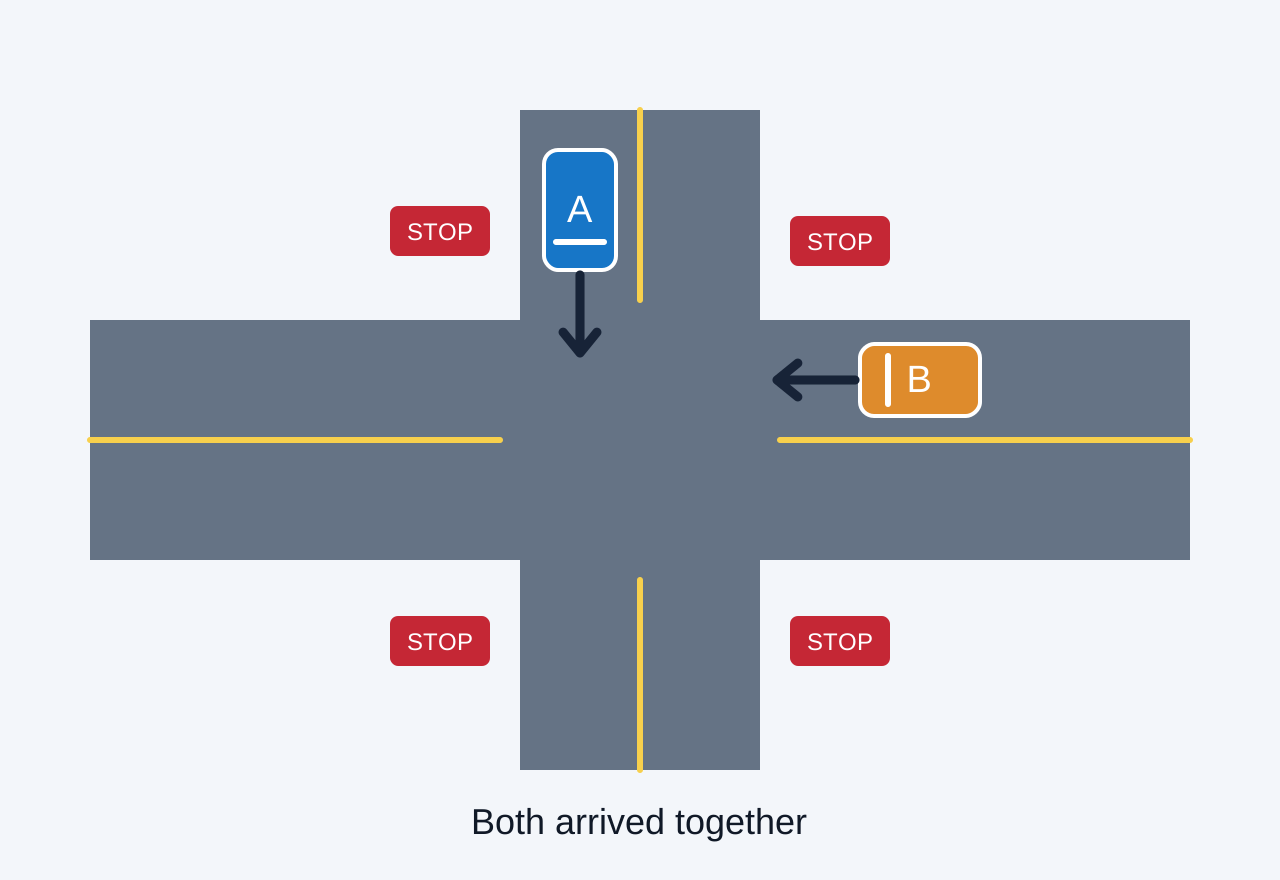
A and B stop at an all-way stop at the same time. A is on B's right. Who normally goes first?
- A. Whichever driver starts moving first
- B. Whichever driver has the larger vehicle
- C. B, because B is on A's left
- D. A, because A is on B's right
Show answer
Answer: D. A, because A is on B's right
When two drivers arrive at an all-way stop together, the driver on the right usually goes first. Neither should move unless it is safe.
Question 6 · Parking
Before reversing out of a driveway, what is a good habit?
- A. Sound the horn and then reverse quickly
- B. Rely only on the backup camera to check
- C. Walk around the vehicle to check for children
- D. Skip looking if you reverse there every day
Show answer
Answer: C. Walk around the vehicle to check for children
Walking around the vehicle helps you see hazards that mirrors and cameras miss.
Question 7 · Highways
A highway on-ramp has a yield sign. What must you do?
- A. Yield to highway traffic, stopping if needed
- B. Stop at the sign every time, even if clear
- C. Treat it the same as an ordinary merge
- D. Merge at your speed; others must make room
Show answer
Answer: A. Yield to highway traffic, stopping if needed
A yield sign means you must give way to traffic it protects.
Question 8 · Licensing
What is the youngest age at which a person can apply for an Alberta Class 7 learner's licence?
- A. 14
- B. 16
- C. 15
- D. 12
Show answer
Answer: A. 14
In Alberta you can apply for a Class 7 learner's licence at 14, if you meet the other requirements, including parental consent.
Question 9 · Intersections
You are in a roundabout and plan to take the third exit. When should you turn on your right signal?
- A. Before entering the roundabout, so everyone knows your plan early
- B. After passing the exit before the one you will use
- C. Right after you enter the circle
- D. After you have left the roundabout
Show answer
Answer: B. After passing the exit before the one you will use
Signal right after you pass the exit just before yours.
Question 10 · Vehicle Preparation
What should you clear before driving after a snowfall?
- A. All windows, mirrors, lights and the roof
- B. Only the front windshield and wipers
- C. Only the driver's window
- D. Nothing, it will melt
Show answer
Answer: A. All windows, mirrors, lights and the roof
Clear everything so you can see and be seen.
Question 11 · Signs and Signals
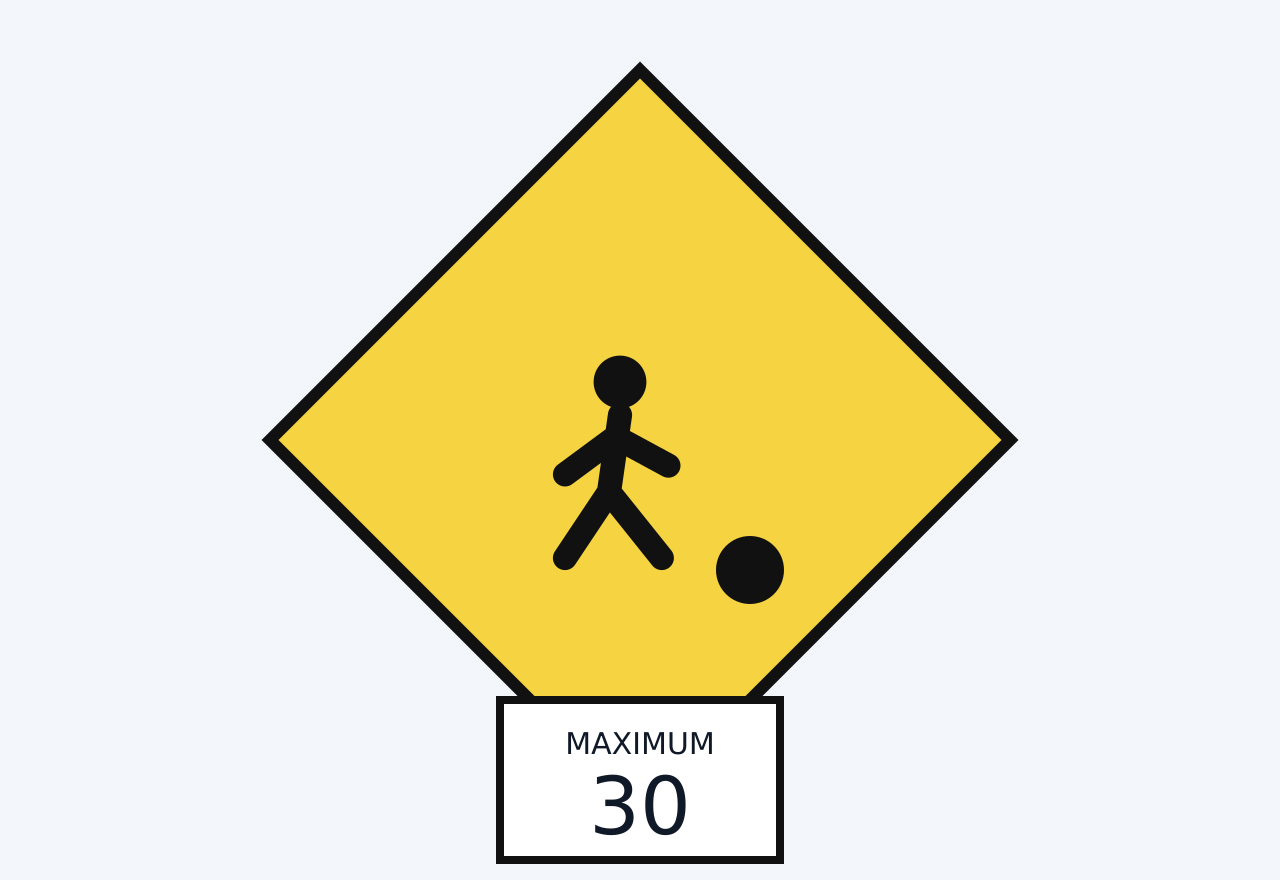
What does this sign with its speed tab mean?
- A. A playground zone with a 30 km/h limit during its hours
- B. A school zone that ends each day at 4:30 p.m.
- C. A playground area where 30 km/h is only suggested
- D. A 30 km/h limit that applies only on school days
Show answer
Answer: A. A playground zone with a 30 km/h limit during its hours
The playground sign with a speed tab marks a playground zone with a 30 km/h maximum during its hours.
Question 12 · Safe Driving
You begin to yawn often and drift in your lane. What should you do?
- A. Turn up the music
- B. Open the window and keep going
- C. Stop somewhere safe and rest
- D. Drive faster to get home
Show answer
Answer: C. Stop somewhere safe and rest
Fatigue impairs driving. The only cure is rest.
Question 13 · Hazards
How should you brake in an emergency in a car with ABS?
- A. Pump the brakes quickly
- B. Press firmly and keep steady pressure
- C. Brake lightly so the ABS does not activate
- D. Use the parking brake
Show answer
Answer: B. Press firmly and keep steady pressure
With ABS, apply steady firm pressure. Do not pump.
Question 14 · Sharing the Road
You want to pass a cyclist on a narrow road with oncoming traffic. What should you do?
- A. Honk so the cyclist moves over for you
- B. Pass closely so you stay in your own lane
- C. Pass on the right if there is a shoulder
- D. Slow down and wait until you can pass with room
Show answer
Answer: D. Slow down and wait until you can pass with room
Give cyclists plenty of space. Wait if you cannot pass safely.
Question 15 · Road Scenarios
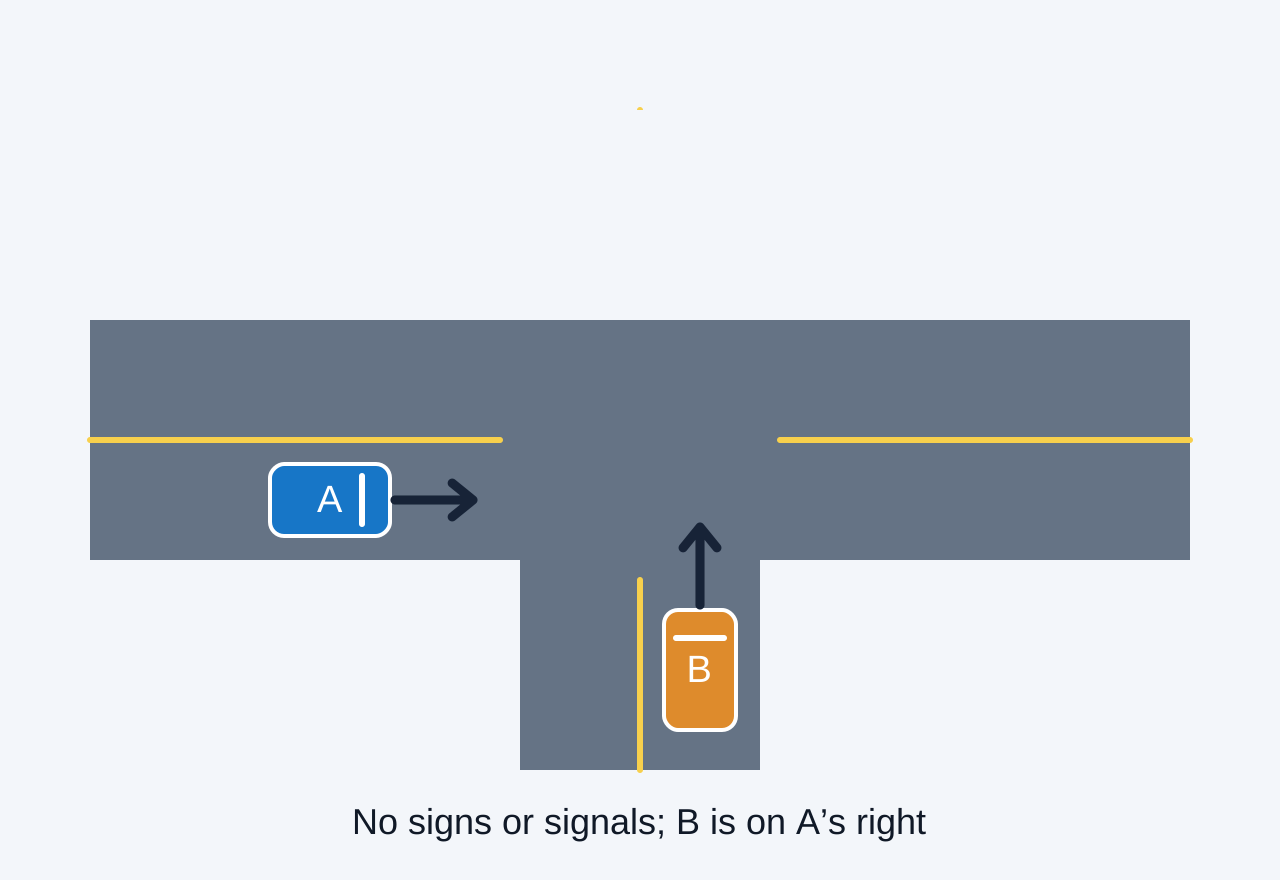
At an uncontrolled T intersection, B is on the stem, on A's right, and their paths conflict. Who should yield?
- A. B, because B's road ends
- B. A, because B is on A's right
- C. A and B both stop and negotiate
- D. Whoever is going faster
Show answer
Answer: B. A, because B is on A's right
At an uncontrolled T intersection, the driver on the right has the right-of-way, even on the road that ends.
Question 16 · Parking
How close to a fire hydrant may you park?
- A. No closer than 1 metre
- B. No closer than 10 metres
- C. No closer than 5 metres
- D. No closer than 3 metres
Show answer
Answer: C. No closer than 5 metres
Do not park within 5 metres of a fire hydrant.
Question 17 · Highways
Another driver is passing you on a two-lane highway. What should you do?
- A. Speed up to stop the pass
- B. Move toward the centre line
- C. Brake suddenly as they pass
- D. Stay in your lane and keep a steady speed or slow slightly
Show answer
Answer: D. Stay in your lane and keep a steady speed or slow slightly
Help the passing driver by not speeding up.
Question 18 · Licensing
A car has five seat belts. How many people may ride in it, including the driver?
- A. Six, if one is a small child
- B. As many as fit safely
- C. Seven, if the trip is short
- D. Five
Show answer
Answer: D. Five
A vehicle may not carry more people than it has seat belts.
Question 19 · Intersections
Three vehicles stop at an all-way stop at different times. Which goes first?
- A. The vehicle going straight
- B. The vehicle on the main road
- C. The vehicle that stopped first
- D. The largest vehicle
Show answer
Answer: C. The vehicle that stopped first
At an all-way stop, the first vehicle to stop proceeds first, when it is safe.
Question 20 · Vehicle Preparation
Why should you check your tires before driving?
- A. Worn or underinflated tires reduce grip
- B. To check that they are the right colour
- C. So you can save time later in the day
- D. Because it is required daily by law
Show answer
Answer: A. Worn or underinflated tires reduce grip
Good tires help you steer and stop.
Ready to test yourself?
Take a 30-question practice exam with the answers hidden. You get a score (pass with 25 of 30, like the real test) and an explanation for every answer. For the real test, see about the Class 7 knowledge test.
More free practice and lessons
- Road signs practice test
- Rules of the road practice test
- Alberta Class 7 Practice Mock Exam 1 with answers
- Alberta Class 7 Practice Mock Exam 2 with answers
- Alberta Class 7 Practice Mock Exam 3 with answers
- Alberta Class 7 Practice Mock Exam 4 with answers
- Alberta Class 7 Practice Mock Exam 5 with answers
- Alberta Class 7 Practice Mock Exam 6 with answers
- Alberta Class 7 Practice Mock Exam 7 with answers
- Reading signs by shape and colour
- Traffic lights and turns on red
- School and playground zones
- Right-of-way at stops and uncontrolled intersections
- Traffic circles and roundabouts
- Parking on hills
- Where you can't park
- Space, scanning and following distance
- Distraction and impairment
- Merging, exiting and passing
- Lane markings and passing
- School buses and emergency vehicles
- Roadside workers, tow trucks and snowplows
- Cyclists, motorcycles and large trucks
- Night, weather and slippery roads
- Skids, blowouts and stalls
- Class 7 learner's licence rules
- Before you drive
- Reading the diagrams
- About the Alberta Class 7 knowledge test
- 7-day study plan
- Study tips