By the ChowChow Labs editorial team · Updated November 13, 2026 · How we check our content
Short answer: Signals control who may enter an intersection. Alberta allows some turns on red after a full stop, and a flashing green has a specific meaning here.
Key points
- Solid red: stop before the stop line, crosswalk or intersection.
- Right on red: allowed after a full stop unless a sign prohibits it.
- Left on red: only from a one-way street onto another one-way street, after a full stop.
- Yellow: stop if you can do it safely; if you're already in the intersection, clear it.
- Flashing red works like a stop sign. Flashing yellow means proceed with caution.
- Flashing green (Alberta): you may go through or turn without stopping while opposing traffic faces red. Still yield to pedestrians.
Law or advice?
All of these are legal rules. Watching the pedestrian signal to predict a light change is good practice.
Example
You're on a one-way street at a red light and want to turn left onto another one-way street. Stop fully, yield to pedestrians and traffic, then turn from the lane nearest the left side.
Checked against the Government of Alberta Driver’s Guide (Spring 2026), used under the Open Government Licence – Alberta. Laws change, so check alberta.ca for the current rules before you rely on a number. Sources: Alberta Driver’s Guide, page 22: Traffic control signals.
Check yourself
Try these 6 questions from our free mock exams, then tap Show answer. For more, take the road signs practice test.
Question 1 · Signs and Signals
When is a left turn at a red light permitted in Alberta?
- A. From any street, as long as no oncoming traffic is near the intersection
- B. From a one-way street onto another one-way street, after a full stop
- C. Never; it is always prohibited
- D. From a two-way street onto a one-way street only
Show answer
Answer: B. From a one-way street onto another one-way street, after a full stop
The only left turn allowed on red is from a one-way onto a one-way, after stopping and yielding.
Question 2 · Signs and Signals
The light turns yellow as you approach. You can stop safely before the line. What should you do?
- A. Stop before the line
- B. Continue at the same speed
- C. Stop in the intersection
- D. Speed up to get through
Show answer
Answer: A. Stop before the line
A yellow light means stop if you can do so safely.
Question 3 · Signs and Signals
You face a solid red light and want to go straight. What must you do?
- A. Stop before the stop line or crosswalk and wait for green
- B. Stop only if a pedestrian is waiting to cross
- C. Stop, then go straight once the road is clear in both directions
- D. Slow down and go straight if no one is coming
Show answer
Answer: A. Stop before the stop line or crosswalk and wait for green
At a solid red light you must stop and stay stopped, except for permitted turns.
Question 4 · Signs and Signals
You want to turn right at a red light. No sign prohibits it. What must you do first?
- A. Wait for the light to turn green
- B. Sound your horn to warn any pedestrians
- C. Slow down and turn if the way looks clear of traffic and people
- D. Come to a complete stop before the stop line or crosswalk
Show answer
Answer: D. Come to a complete stop before the stop line or crosswalk
Right turns on red are allowed after a complete stop, unless a sign prohibits them.
Question 5 · Signs and Signals

You reach this sign at a quiet neighbourhood intersection. What must you do?
- A. Stop only when pedestrians are in the crosswalk
- B. Slow to a crawl and continue if nothing is coming
- C. Come to a full stop, then go only when the way is clear
- D. Stop only if another vehicle is already waiting
Show answer
Answer: C. Come to a full stop, then go only when the way is clear
This sign always requires a complete stop. After stopping, yield to pedestrians and traffic before moving on.
Question 6 · Signs and Signals
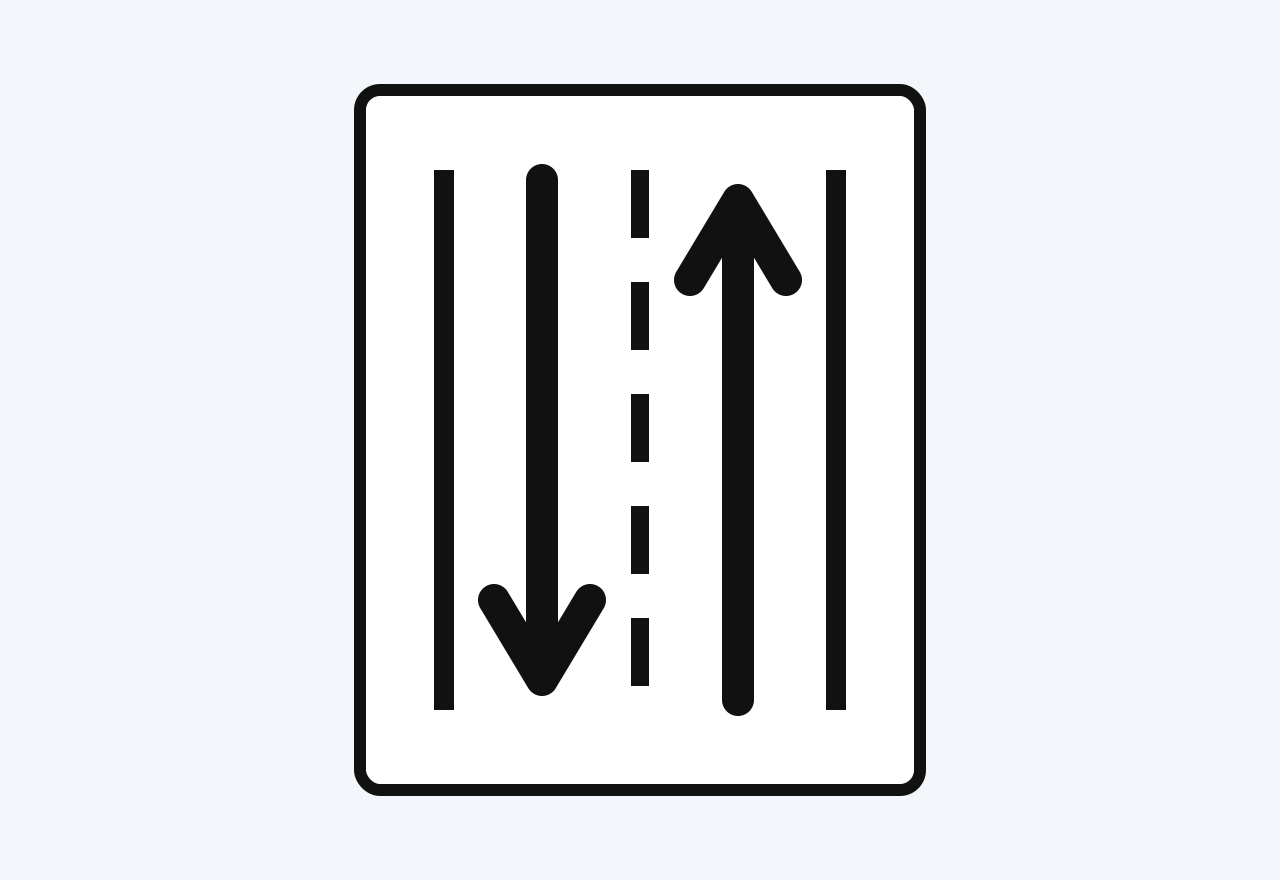
What does this sign tell you?
- A. You may pass on either side of the vehicle ahead
- B. The road divides into two separate roadways
- C. Two lanes ahead travel the same direction as you
- D. Traffic travels in both directions on this road
Show answer
Answer: D. Traffic travels in both directions on this road
The opposing arrows show two-way traffic. Expect vehicles coming toward you.
Next: School and playground zones. School and playground zones protect children with a lower speed during set hours. The two zones run on different schedules.