Alberta Class 7 Practice Mock Exam 3
All 30 questions from Mock Exam 3, with answers and explanations.
A mixed exam: 6 sign questions, 6 road diagrams and 18 questions on the rules of the road, including hazards, safe driving and highways.
These are the 30 questions from Mock Exam 3, original practice questions on signs and the rules of the road, checked against the Alberta Driver’s Guide. Read through them with Show answer, or take the exam online first with the answers hidden and see your score. No sign-in needed.
These are original practice questions, not actual knowledge test questions. Each links to the page of the Alberta Driver’s Guide it’s based on, so you can check the rule. Questions were last reviewed in October 2026; read how we write and check them.
Question 1 · Signs and Signals
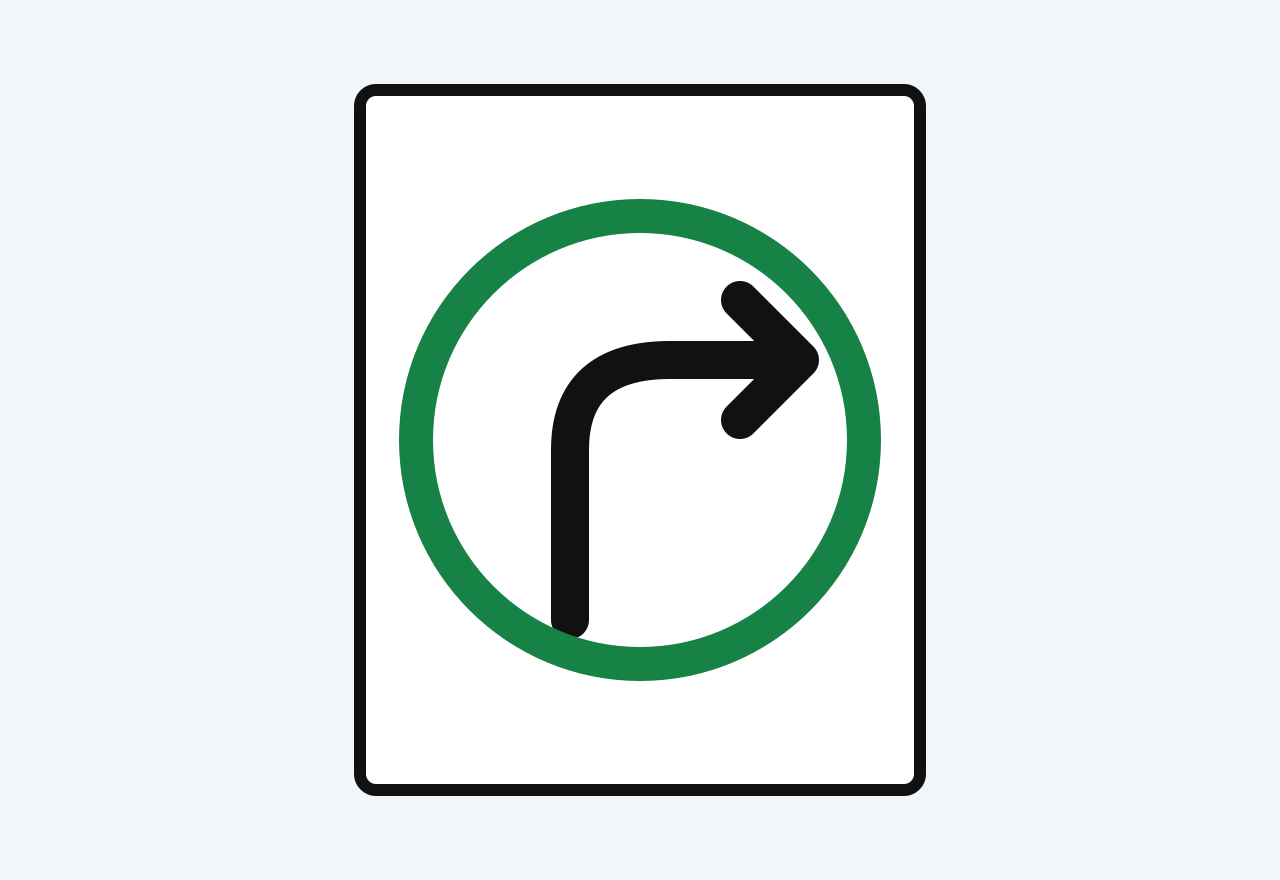
What does this sign mean?
- A. Right turns are not allowed here
- B. You must turn right; going straight is not allowed
- C. Right turns are allowed only on red
- D. The right-turn movement shown is allowed
Show answer
Answer: D. The right-turn movement shown is allowed
A green circle around an arrow shows a permitted movement.
Question 2 · Highways
Within an urban area, may you safely pass across a single solid yellow line?
- A. No, never across any solid yellow line in Alberta
- B. Only at night
- C. Yes, if it is safe and no other rule prohibits it
- D. Only when traffic ahead is stopped
Show answer
Answer: C. Yes, if it is safe and no other rule prohibits it
Alberta permits safely passing across a single solid yellow line in an urban area.
Question 3 · Parking
How close to a marked crosswalk may you park?
- A. No closer than 1 metre from its nearest side
- B. Right up to the edge of the crosswalk lines
- C. No closer than 5 metres from its nearest side
- D. No closer than 50 metres from either side
Show answer
Answer: C. No closer than 5 metres from its nearest side
Do not park within 5 metres of the nearest side of a marked crosswalk.
Question 4 · Safe Driving
Which child safety seats may be used in Canada?
- A. Any seat sold by an online retailer
- B. Seats labelled as meeting Canadian safety standards
- C. Seats approved for use in any other country
- D. Any seat that fits
Show answer
Answer: B. Seats labelled as meeting Canadian safety standards
Use only child seats with a label showing they meet Canadian standards.
Question 5 · Highways
You miss your exit on a highway. What should you do?
- A. Turn across the median
- B. Stop and back up
- C. Use the shoulder to reverse
- D. Continue to the next exit
Show answer
Answer: D. Continue to the next exit
Never reverse or make a U-turn on a highway. Take the next exit.
Question 6 · Road Scenarios
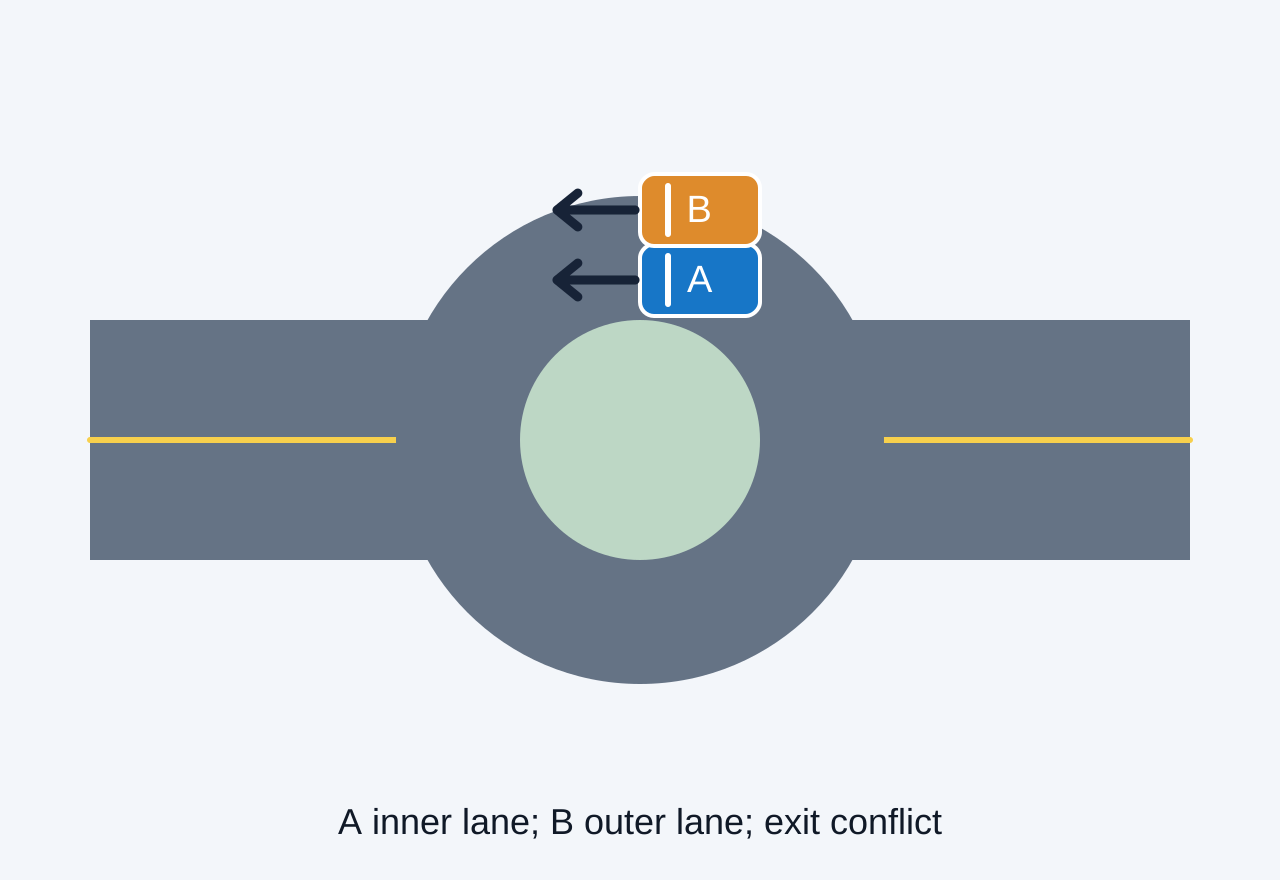
In a two-lane traffic circle, A (inside lane) wants the next exit. B is beside A in the outside lane, going around. Who must yield?
- A. A, because A is the one crossing over B's lane to leave
- B. B, because outside-lane drivers yield to inside-lane drivers
- C. Whichever driver reaches the exit first
- D. Both must stop until the other one moves
Show answer
Answer: B. B, because outside-lane drivers yield to inside-lane drivers
In Alberta, drivers in the right (outside) lane of a circle must yield to drivers on the left (inside).
Question 7 · Sharing the Road
An emergency vehicle approaches on a one-way street. Where should you pull over?
- A. Always to the right, even if you must cross lanes
- B. Always to the left
- C. To the nearest curb, left or right
- D. Stop in your lane
Show answer
Answer: C. To the nearest curb, left or right
On a one-way street, move to the nearest curb and stop.
Question 8 · Signs and Signals
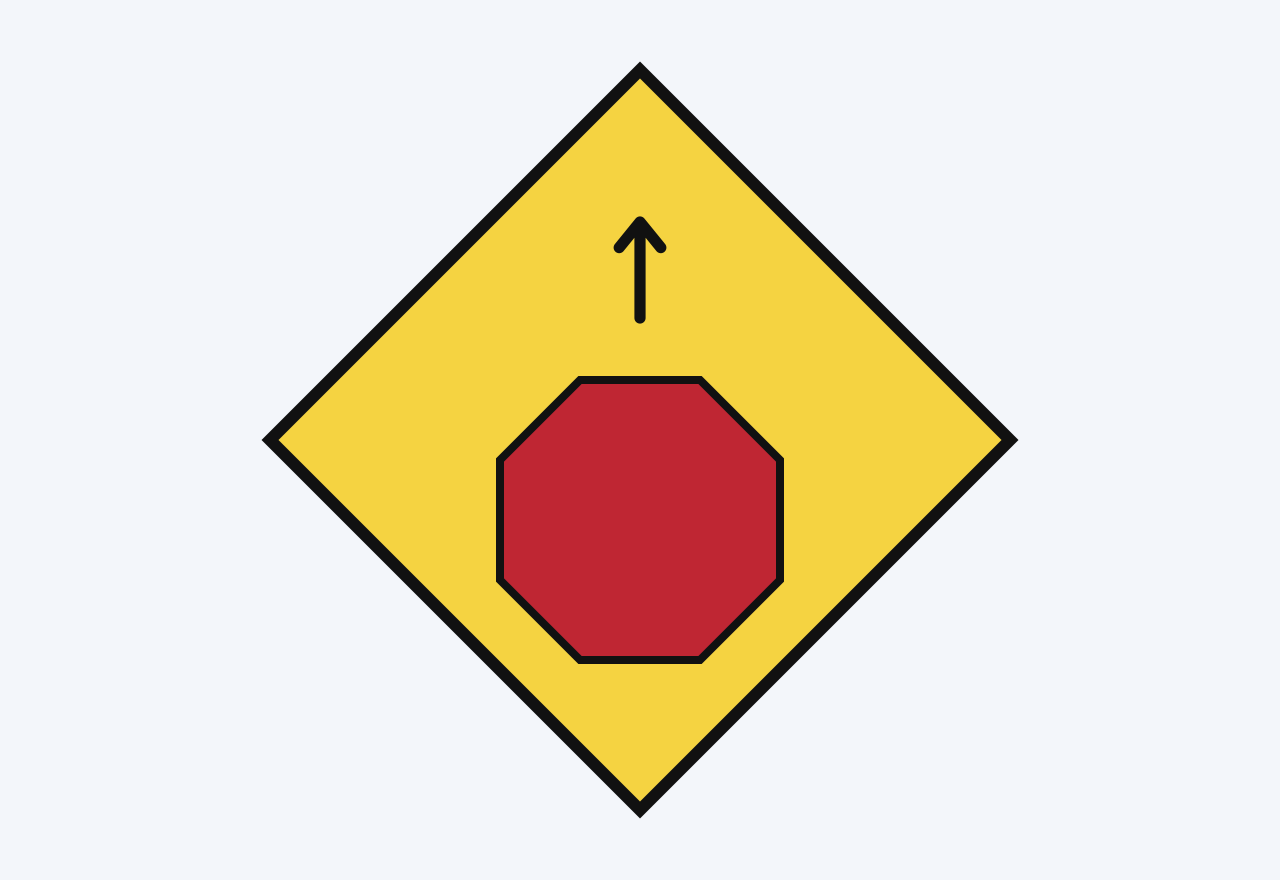
What does this sign warn you about?
- A. A stop sign is ahead
- B. The road ahead is closed
- C. You must stop right here at this sign
- D. A traffic light is ahead
Show answer
Answer: A. A stop sign is ahead
This sign warns of a stop sign ahead, often where it is hard to see. Get ready to stop.
Question 9 · Safe Driving
A driver is following you too closely. What is the safest response?
- A. Speed up to get away
- B. Keep a steady speed and let them pass when possible
- C. Slow way down so they get frustrated
- D. Brake suddenly to warn them to back off from your bumper
Show answer
Answer: B. Keep a steady speed and let them pass when possible
Staying calm and letting the tailgater pass reduces risk.
Question 10 · Licensing
Who may supervise a Class 7 learner while they drive?
- A. Any adult passenger with a licence, seated anywhere in the vehicle
- B. Another learner who has held a Class 7 licence for over a year
- C. A fully licensed (non-GDL) driver, 18 or older, seated beside the learner
- D. Any licensed driver over 16, including one on a probationary licence
Show answer
Answer: C. A fully licensed (non-GDL) driver, 18 or older, seated beside the learner
The supervisor must be a fully licensed driver, not in the GDL program, at least 18, and seated next to the learner.
Question 11 · Safe Driving
How should the lap part of a seat belt be worn?
- A. Under one leg
- B. Across the stomach
- C. Low across the hips
- D. Loose around the waist
Show answer
Answer: C. Low across the hips
The lap belt should sit low and snug across the hips, not the stomach.
Question 12 · Vehicle Preparation
A red warning light comes on while you are driving. What should you do?
- A. Check what it means and stop if needed
- B. Turn off the engine immediately
- C. Speed up to get home sooner
- D. Ignore it until your next service
Show answer
Answer: A. Check what it means and stop if needed
Red warning lights can mean serious problems.
Question 13 · Signs and Signals
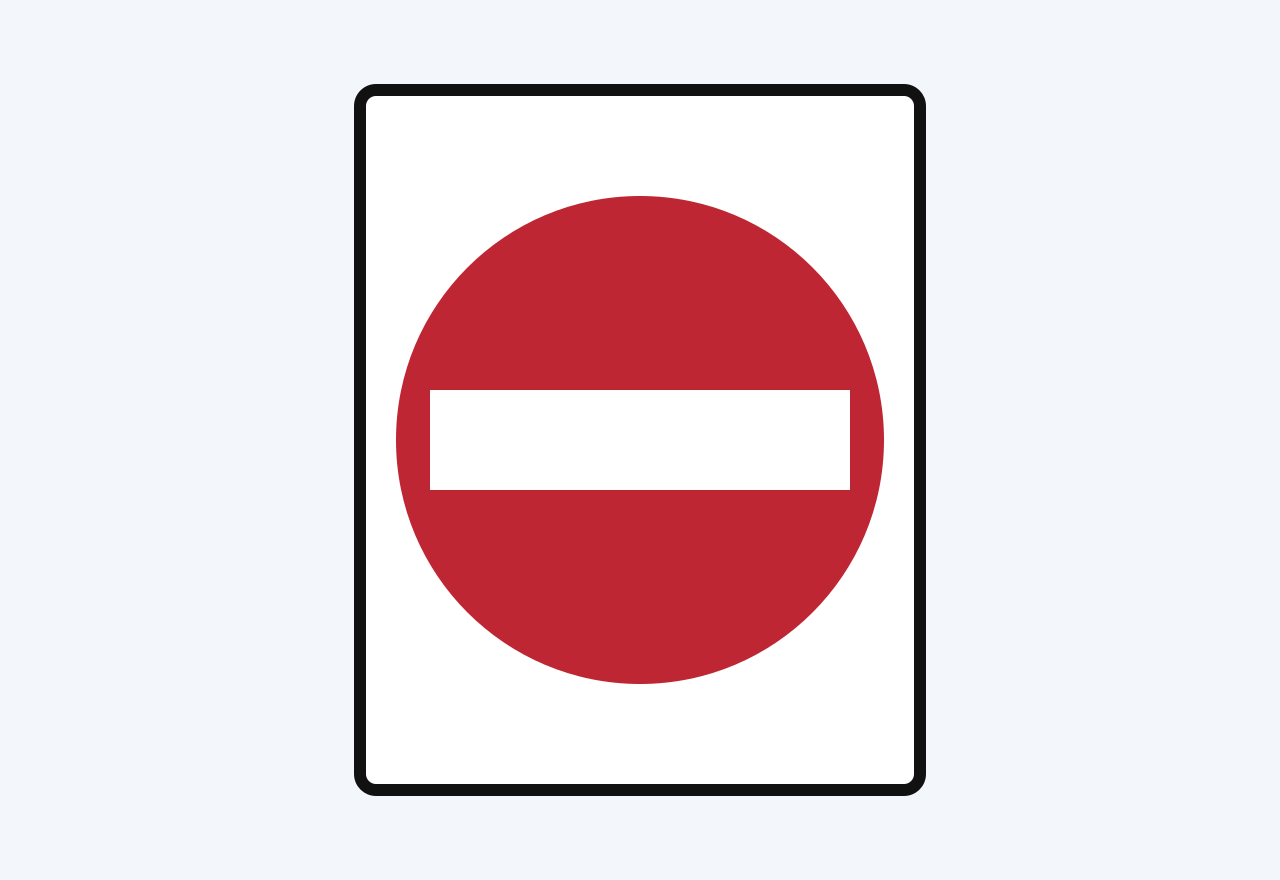
You are about to turn into a street with this sign facing you. What does it tell you?
- A. Stop before entering and yield to cross traffic
- B. Only local traffic may enter the road here
- C. Do not enter the road from this direction
- D. Enter slowly because the road narrows ahead
Show answer
Answer: C. Do not enter the road from this direction
This sign prohibits entry from your direction, usually because traffic on that road flows toward you.
Question 14 · Hazards
Why do bridges and overpasses often freeze before the rest of the road?
- A. They are always made of metal
- B. Cold air passes above and below them
- C. Snowplows are not allowed on them
- D. They are higher than the road
Show answer
Answer: B. Cold air passes above and below them
Bridges lose heat from both sides, so ice forms there first.
Question 15 · Road Scenarios
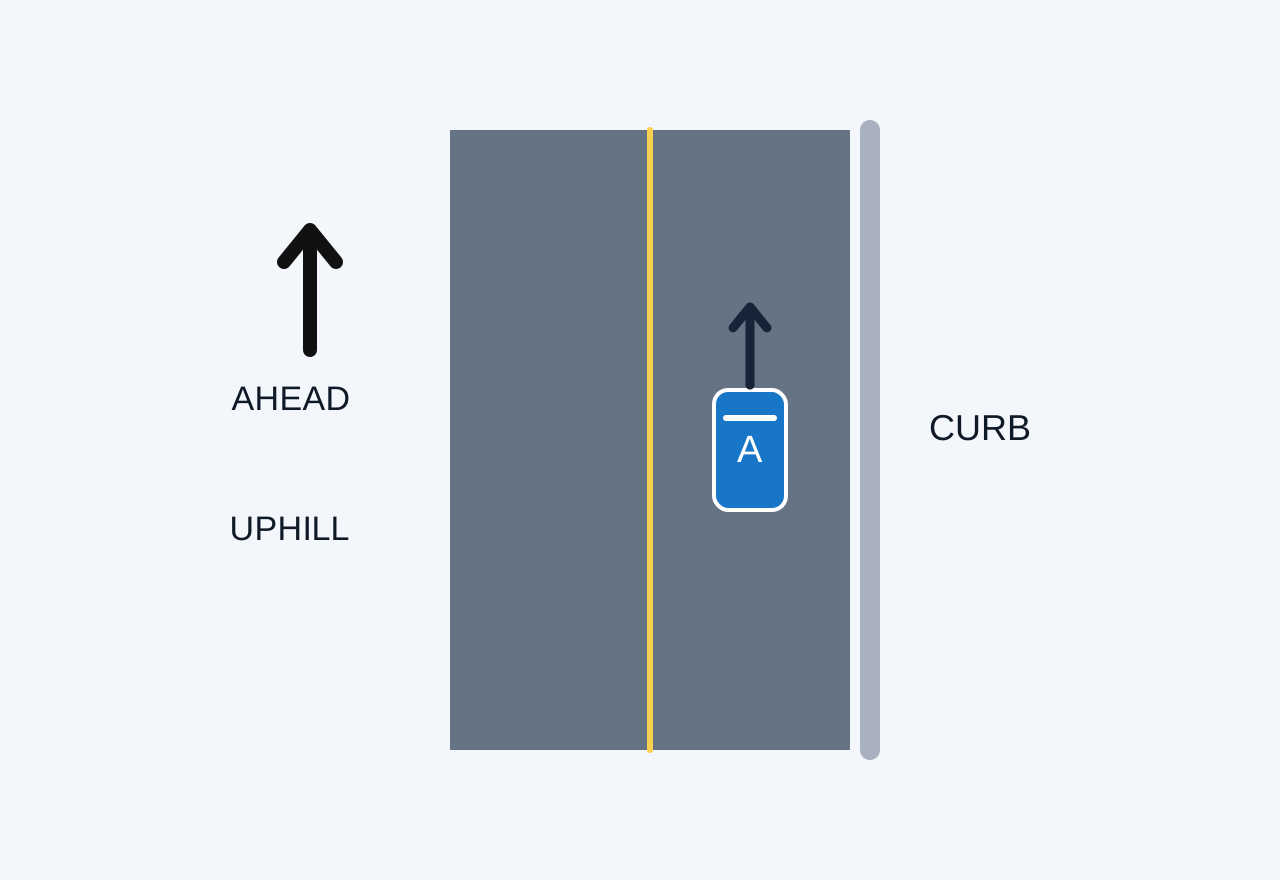
A is parked facing uphill on the right side of the road, beside a curb. Which way should A turn the front wheels?
- A. Right, then back up onto the curb
- B. Right, toward the curb
- C. Left, away from the curb
- D. Straight ahead
Show answer
Answer: C. Left, away from the curb
Facing uphill with a curb, turn the wheels away from the curb.
Question 16 · Road Scenarios
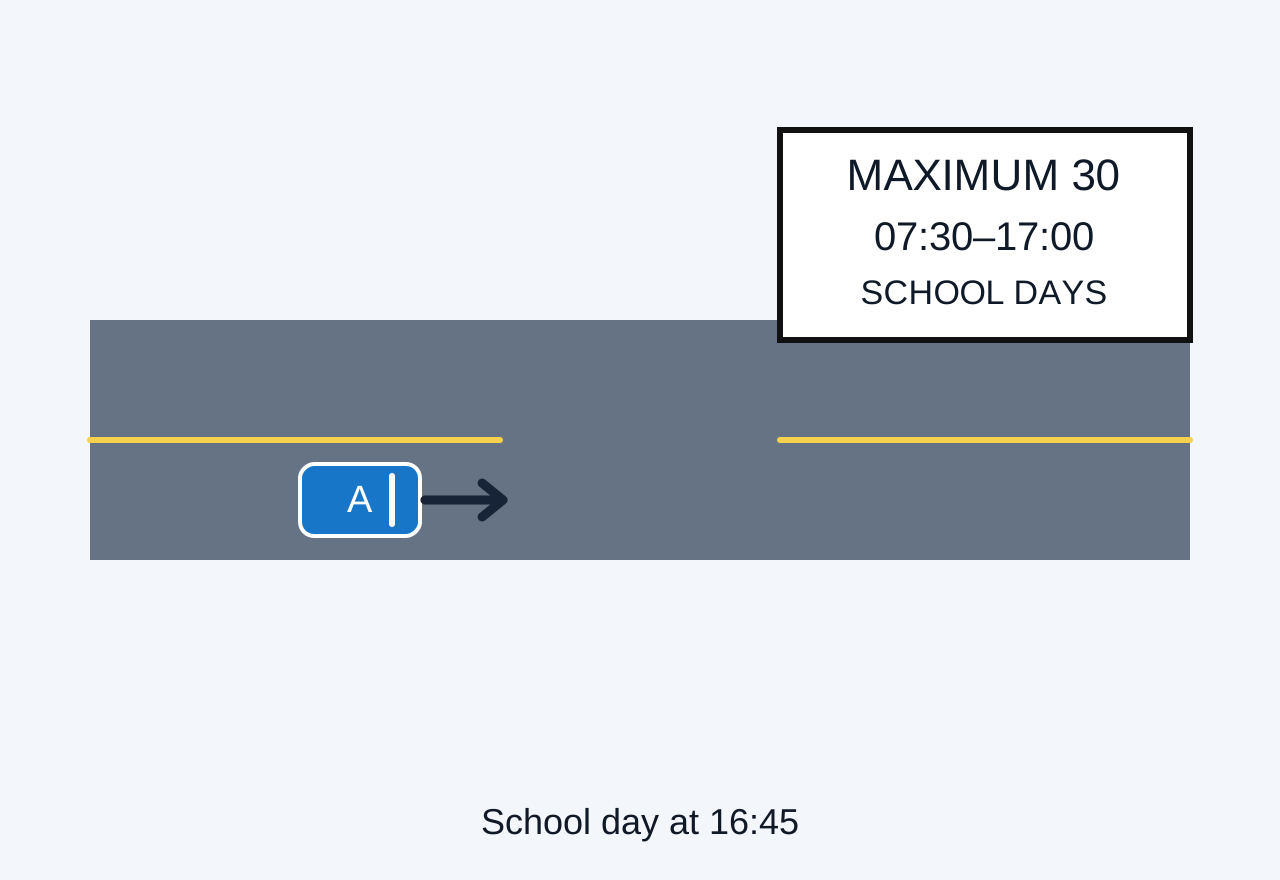
A school-zone sign shows MAXIMUM 30 with a local time tab: 07:30–17:00 SCHOOL DAYS. It's 16:45 on a school day. What applies?
- A. The zone is not active, since provincial times end at 4:30
- B. 30 km/h is a suggested minimum
- C. The 30 km/h limit is in effect
- D. The limit applies only if children are visible
Show answer
Answer: C. The 30 km/h limit is in effect
When a local time tab is posted, those times apply instead of the provincial hours.
Question 17 · Hazards
Your car stalls on railway tracks. What should you do first?
- A. Push the car off
- B. Stay inside the car with your seat belt fastened
- C. Get everyone out and away from the tracks
- D. Try to restart the car
Show answer
Answer: C. Get everyone out and away from the tracks
Getting people away is the top priority.
Question 18 · Signs and Signals
A construction zone shows a reduced speed limit, but no workers are visible. What should you do?
- A. Use the reduced limit only during weekdays
- B. Obey the reduced speed limit
- C. Return to the normal limit
- D. Drive slightly over the reduced limit
Show answer
Answer: B. Obey the reduced speed limit
Posted construction speeds apply whenever they are displayed, workers or not.
Question 19 · Road Scenarios
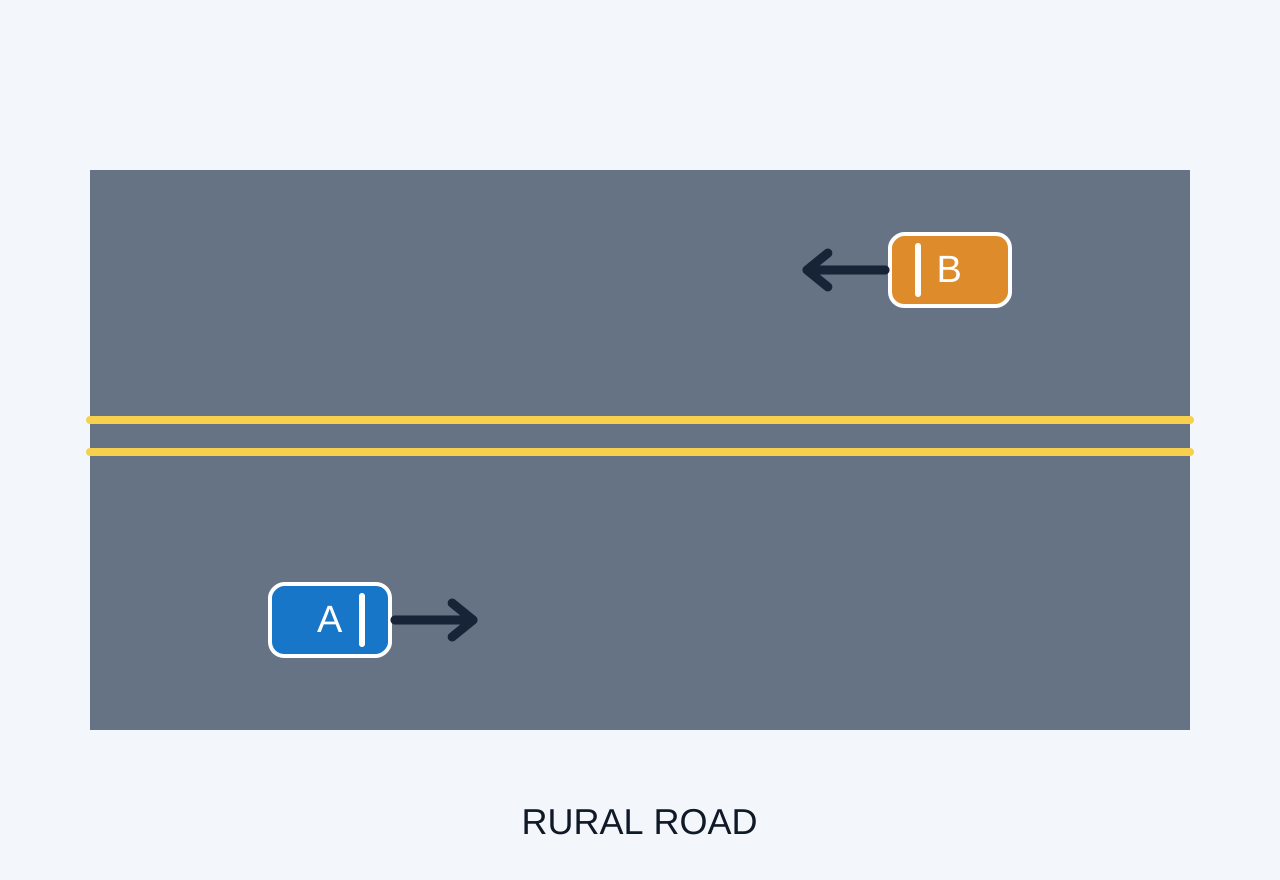
A wants to pass a slow vehicle on a rural road. The centre line beside A's lane is solid yellow. What should A do?
- A. Pass using the urban single-line exception
- B. Pass after a long horn warning
- C. Stay behind and not cross the solid line to pass
- D. Pass, since the car ahead is slow
Show answer
Answer: C. Stay behind and not cross the solid line to pass
Outside urban areas, a solid yellow line on your side means passing is not allowed.
Question 20 · Intersections
At a T intersection with no signs or signals, who has the right-of-way?
- A. Whoever is going faster
- B. The driver on the road that ends
- C. The driver on the right
- D. The driver on the road that continues
Show answer
Answer: C. The driver on the right
In Alberta, an uncontrolled T intersection follows the right-hand rule.
Question 21 · Signs and Signals
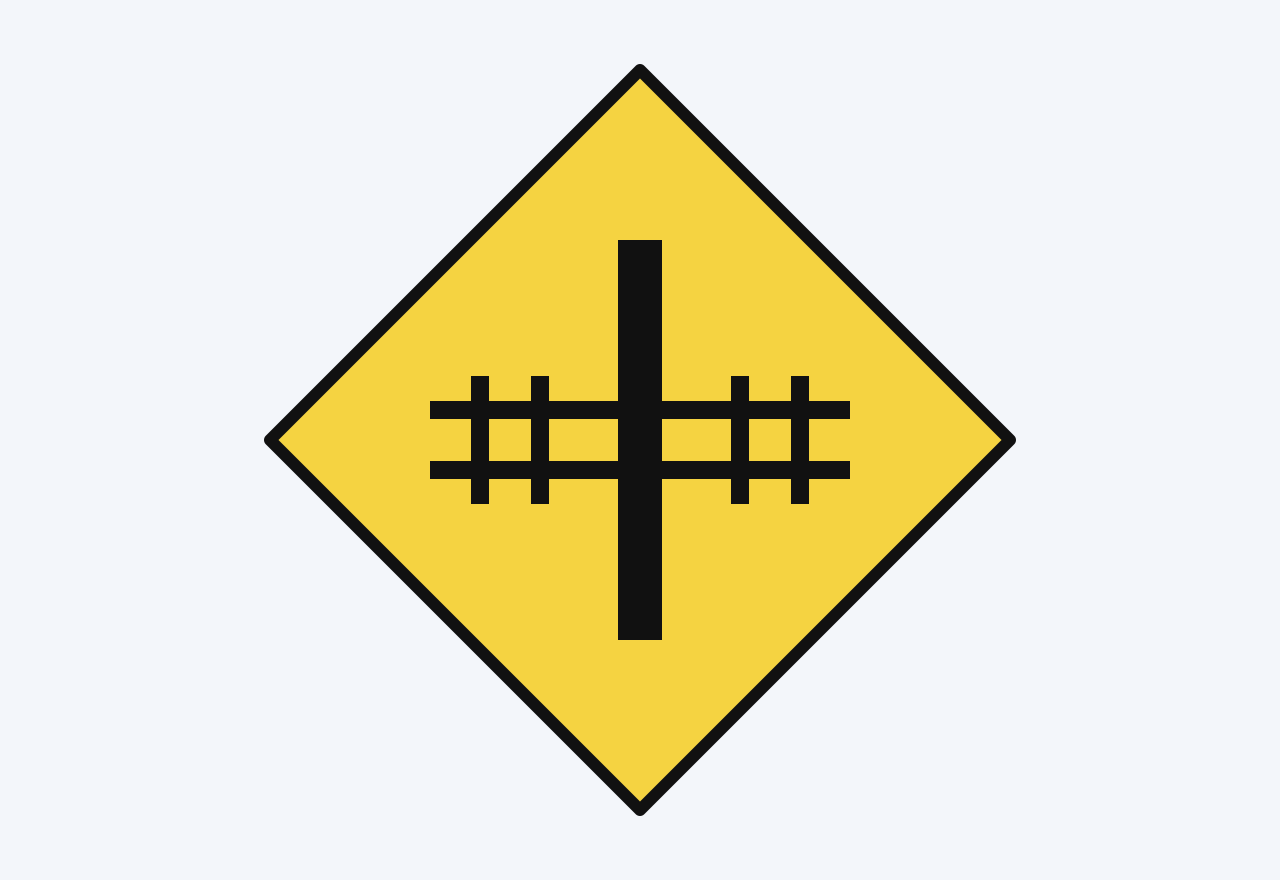
What does this sign warn you about?
- A. An intersection with a four-way stop
- B. A crossing for farm animals
- C. A road reserved for rail workers
- D. A railway crossing is ahead
Show answer
Answer: D. A railway crossing is ahead
This advance warning tells you that a railway crossing is coming, so you can prepare to stop.
Question 22 · Road Scenarios
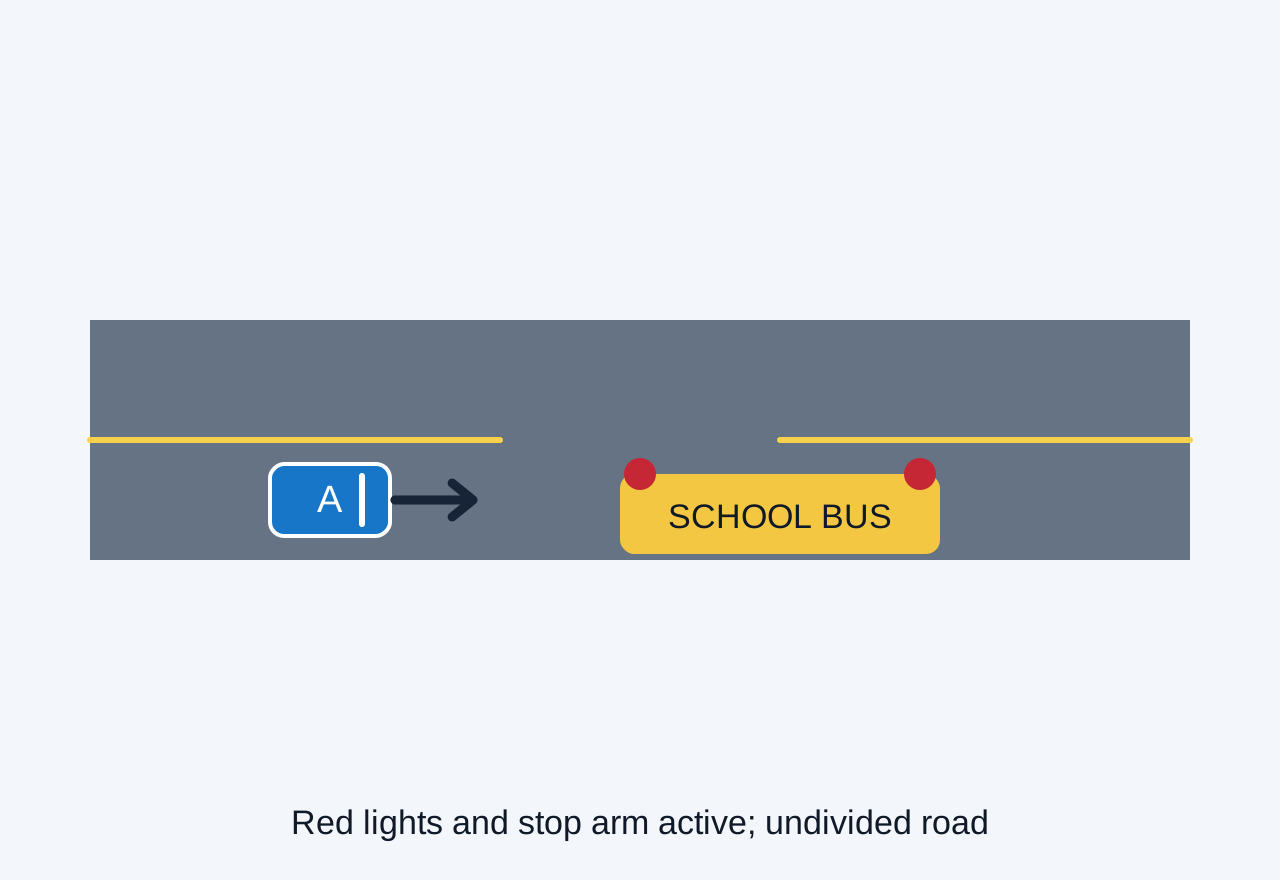
A is behind a stopped school bus with red lights flashing and stop arm out, on an undivided road. What should A do?
- A. Stop and stay stopped until the lights go off and the arm is folded
- B. Pass slowly on the left, as long as no children can be seen near the bus
- C. Stop briefly, then pass carefully at walking speed
- D. Honk and pass as soon as the bus doors have closed
Show answer
Answer: A. Stop and stay stopped until the lights go off and the arm is folded
On an undivided road, traffic must stop for a school bus with flashing red lights and its stop arm extended.
Question 23 · Signs and Signals
You are driving into a new town and see no speed signs yet. What should you do?
- A. Watch for posted limits and drive to suit the area
- B. Keep your highway speed until you see a sign
- C. Assume every town in Alberta is 70 km/h
- D. Drive at 30 km/h until you see a sign
Show answer
Answer: A. Watch for posted limits and drive to suit the area
Limits can vary by municipality. Watch for posted signs and drive to suit the area.
Question 24 · Signs and Signals
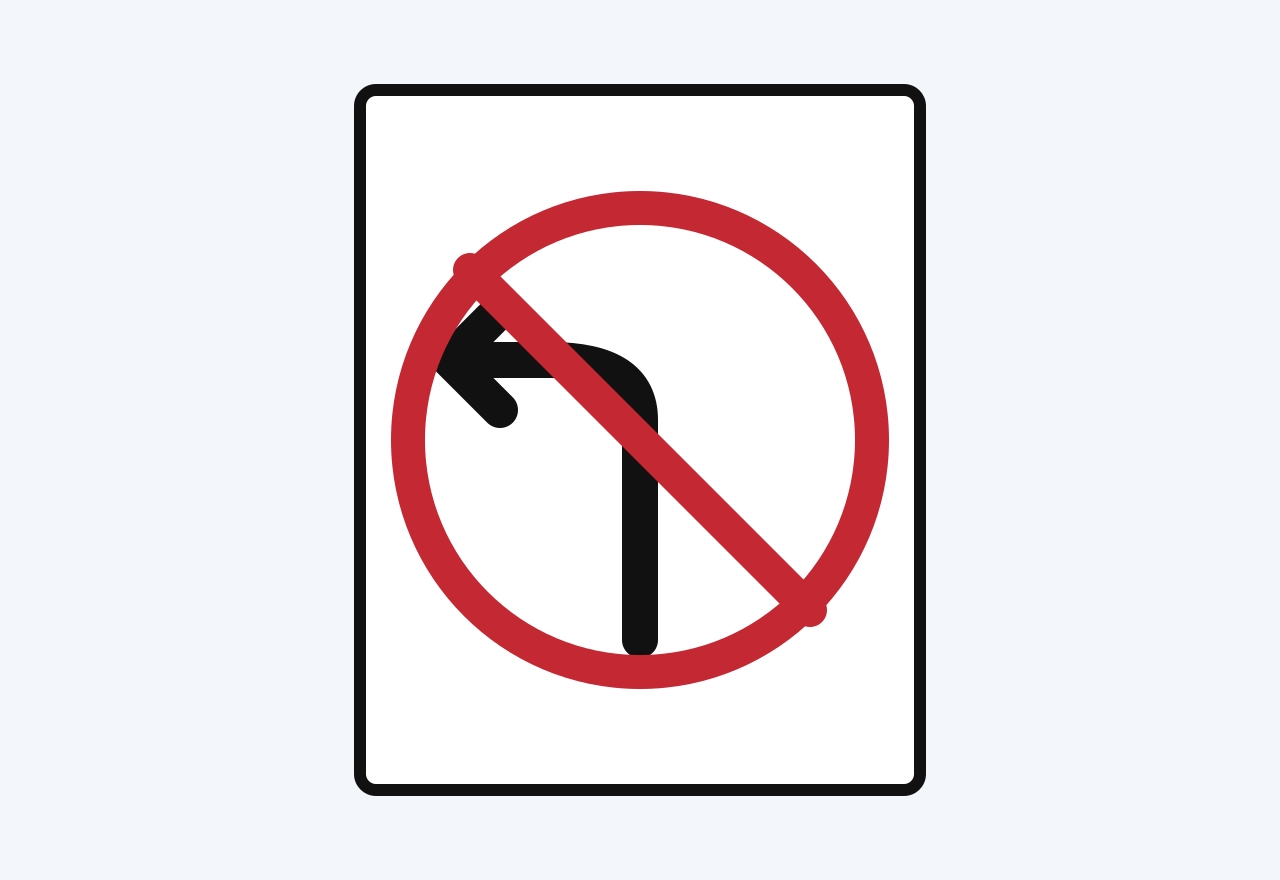
What does this sign mean?
- A. Left turns are allowed only on a green arrow
- B. The left lane ends ahead
- C. Traffic from the left must stop
- D. Left turns are not allowed here
Show answer
Answer: D. Left turns are not allowed here
The left-turning arrow with a red slash prohibits left turns at this location.
Question 25 · Sharing the Road
A school bus ahead has alternating amber lights flashing. What do they mean?
- A. The bus is about to pull away
- B. The bus has broken down
- C. You must stop right away
- D. The bus is preparing to stop
Show answer
Answer: D. The bus is preparing to stop
Amber lights warn that the red lights are about to begin and the bus is stopping.
Question 26 · Parking
You park facing downhill next to a curb. Which way should you turn your front wheels?
- A. Away from the curb
- B. Straight
- C. Toward the curb
- D. It does not matter
Show answer
Answer: C. Toward the curb
Facing downhill, turn the wheels toward the curb so a rolling car goes into the curb.
Question 27 · Signs and Signals
What does a flashing red traffic light mean?
- A. Slow down and proceed with caution
- B. Stop completely, then go when it is safe, as at a stop sign
- C. The light is broken, so treat the intersection as if it had no signal at all
- D. Stop only if other vehicles are there
Show answer
Answer: B. Stop completely, then go when it is safe, as at a stop sign
A flashing red light has the same meaning as a stop sign.
Question 28 · Hazards
Your right wheels drop off the pavement edge. What should you do?
- A. Hold the wheel, ease off the gas, return when safe
- B. Brake hard while the wheels are off the edge
- C. Jerk the wheel back onto the pavement at once
- D. Speed up to climb back onto the pavement
Show answer
Answer: A. Hold the wheel, ease off the gas, return when safe
Sudden steering can cause loss of control.
Question 29 · Signs and Signals
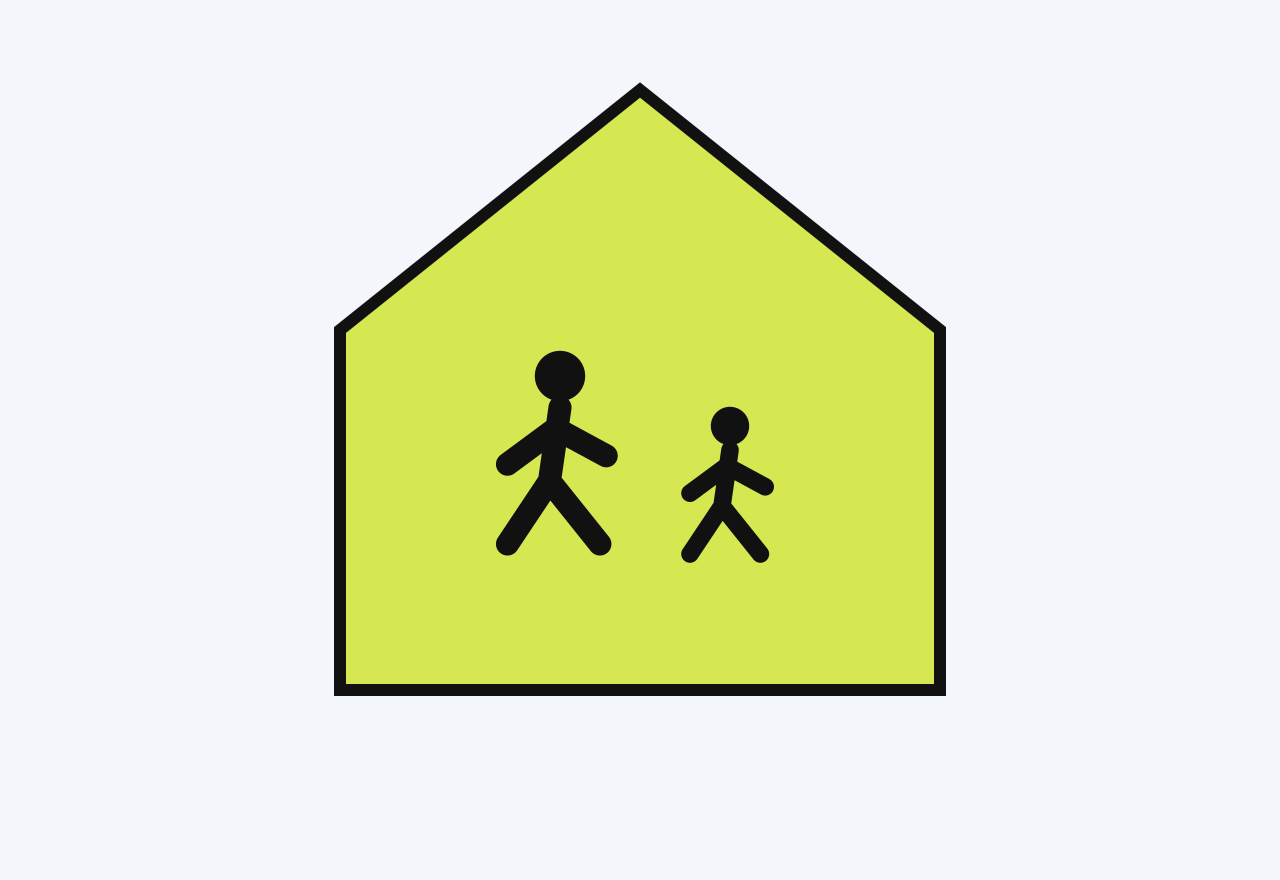
What does this sign without a speed tab warn you about?
- A. School buses must not be passed here
- B. A school is nearby, so watch for children
- C. Parking is reserved for school staff
- D. A 30 km/h limit applies right now
Show answer
Answer: B. A school is nearby, so watch for children
This school-area sign warns of children. On its own, without a speed tab, it does not set a reduced speed.
Question 30 · Road Scenarios
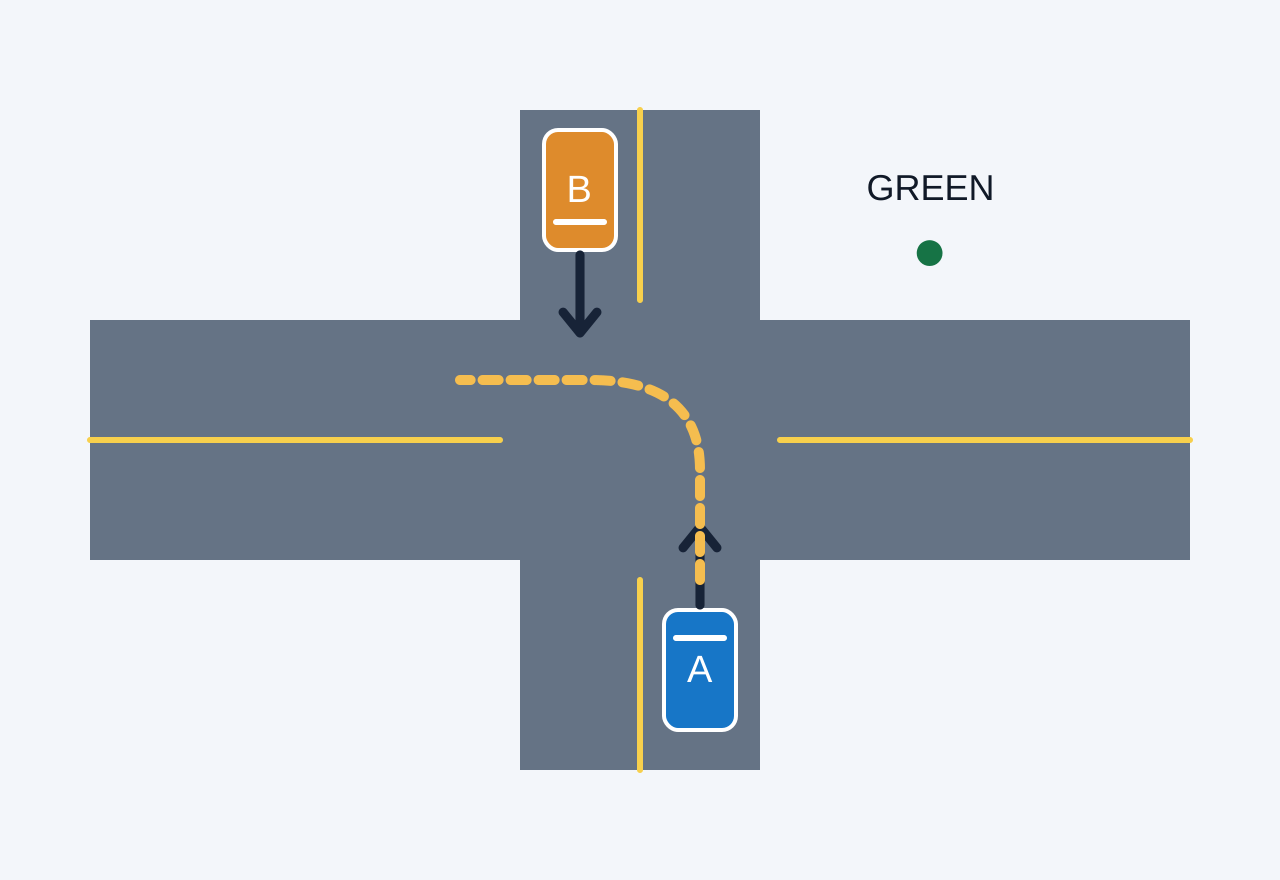
A is turning left on a solid green. Oncoming B is going straight. What should A do?
- A. Wait for B to pass, then turn when it is safe
- B. Turn at the same time and steer around B
- C. Turn first, because A signalled first
- D. Turn quickly, since a green light protects A
Show answer
Answer: A. Wait for B to pass, then turn when it is safe
A solid green light does not protect a left turn. Left-turning drivers must yield to oncoming traffic.
Ready to test yourself?
Take a 30-question practice exam with the answers hidden. You get a score (pass with 25 of 30, like the real test) and an explanation for every answer. For the real test, see about the Class 7 knowledge test.
More free practice and lessons
- Free Alberta Class 7 practice test
- Road signs practice test
- Rules of the road practice test
- Alberta Class 7 Practice Mock Exam 1 with answers
- Alberta Class 7 Practice Mock Exam 2 with answers
- Alberta Class 7 Practice Mock Exam 4 with answers
- Alberta Class 7 Practice Mock Exam 5 with answers
- Alberta Class 7 Practice Mock Exam 6 with answers
- Alberta Class 7 Practice Mock Exam 7 with answers
- Reading signs by shape and colour
- Traffic lights and turns on red
- School and playground zones
- Right-of-way at stops and uncontrolled intersections
- Traffic circles and roundabouts
- Parking on hills
- Where you can't park
- Space, scanning and following distance
- Distraction and impairment
- Merging, exiting and passing
- Lane markings and passing
- School buses and emergency vehicles
- Roadside workers, tow trucks and snowplows
- Cyclists, motorcycles and large trucks
- Night, weather and slippery roads
- Skids, blowouts and stalls
- Class 7 learner's licence rules
- Before you drive
- Reading the diagrams
- About the Alberta Class 7 knowledge test
- 7-day study plan
- Study tips