By the ChowChow Labs editorial team · Updated November 13, 2026 · How we check our content
Short answer: People working at the roadside are at risk from passing traffic.
Key points
- In the lane next to stopped emergency vehicles or tow trucks with lights flashing: 60 km/h or the posted limit, whichever is lower.
- Speeding fines there are doubled.
- Move to a farther lane when you can do it safely.
- Obey construction speeds and flag persons, even with no workers visible.
- Don't pass a snowplow when your view is blocked or it isn't safe.
Law or advice?
The speed rule and flag-person directions are law. Moving over when safe is strongly recommended.
Example
A tow truck is on the shoulder with lights flashing and you can't change lanes on a 100 km/h highway. You slow to 60 km/h while passing.
Checked against the Government of Alberta Driver’s Guide (Spring 2026), used under the Open Government Licence – Alberta. Laws change, so check alberta.ca for the current rules before you rely on a number. Sources: Alberta Driver’s Guide, page 85: Emergency response vehicles and tow trucks.
Check yourself
Try these 6 questions from our free mock exams, then tap Show answer. For more, take the rules of the road practice test.
Question 1 · Sharing the Road
An emergency vehicle with a siren approaches from behind on a two-way road. What should you do?
- A. Move to the left side
- B. Move to the right edge and stop
- C. Speed up and keep going until you find a side road
- D. Stop right in your lane
Show answer
Answer: B. Move to the right edge and stop
On a two-way road, drive as close as possible to the right curb or edge and stop.
Question 2 · Sharing the Road
An emergency vehicle approaches on a one-way street. Where should you pull over?
- A. Always to the right, even if you must cross lanes
- B. Always to the left
- C. To the nearest curb, left or right
- D. Stop in your lane
Show answer
Answer: C. To the nearest curb, left or right
On a one-way street, move to the nearest curb and stop.
Question 3 · Road Scenarios
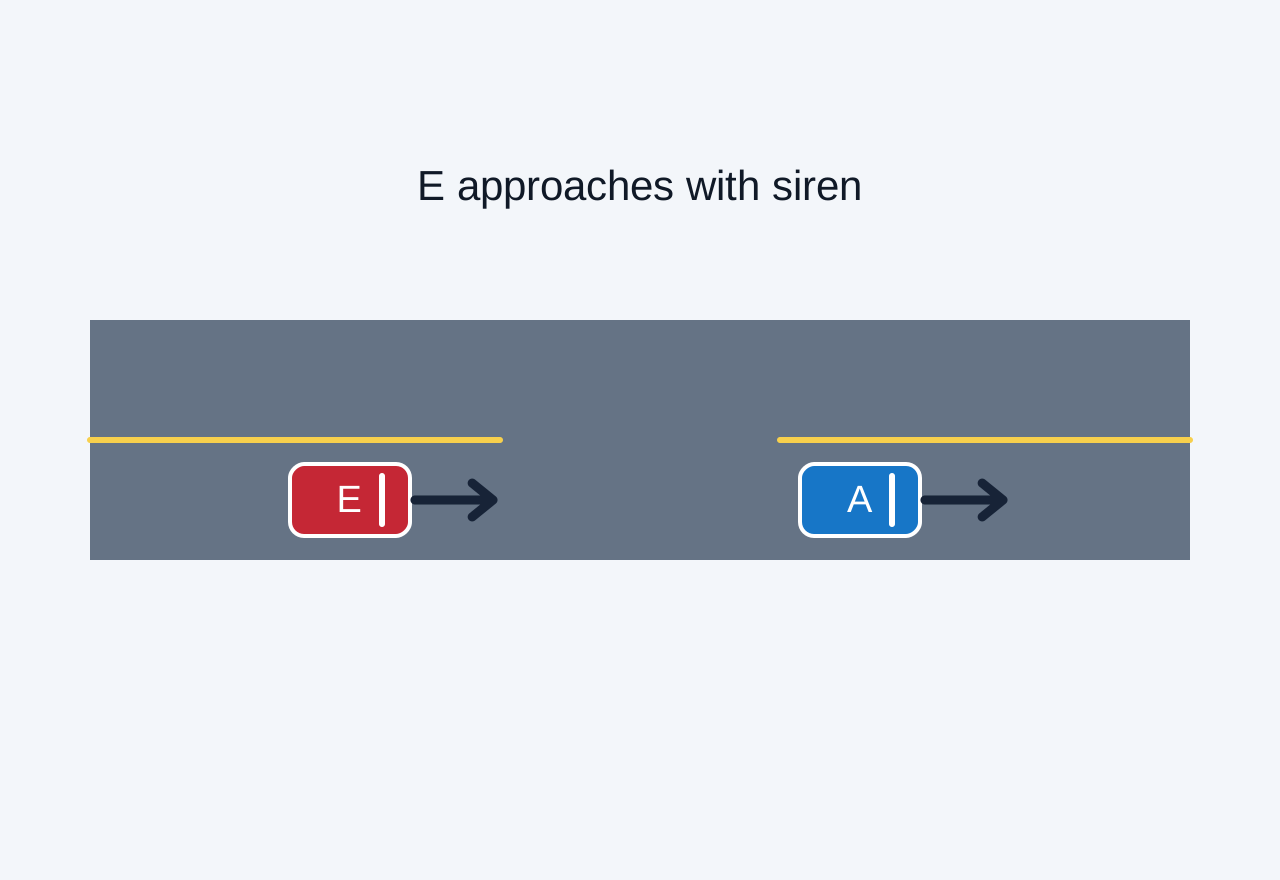
Emergency vehicle E comes up behind A with its siren on. The right edge is clear. What should A do?
- A. Stop right where A is in the lane
- B. Speed up to stay ahead of E
- C. Pull over to the right edge and stop
- D. Move to the left lane so E can pass on the right
Show answer
Answer: C. Pull over to the right edge and stop
On a two-way road, pull over to the right edge and stop to let the emergency vehicle pass.
Question 4 · Sharing the Road
When is passing a snowplow strictly prohibited?
- A. When your view along its side is blocked
- B. Only at night
- C. Only on weekends
- D. Never; passing a snowplow is always allowed when it is slow
Show answer
Answer: A. When your view along its side is blocked
You may not pass if the view is obstructed, if passing would interfere, or if it cannot be done safely.
Question 5 · Sharing the Road
You want to pass a cyclist on a narrow road with oncoming traffic. What should you do?
- A. Honk so the cyclist moves over for you
- B. Pass closely so you stay in your own lane
- C. Pass on the right if there is a shoulder
- D. Slow down and wait until you can pass with room
Show answer
Answer: D. Slow down and wait until you can pass with room
Give cyclists plenty of space. Wait if you cannot pass safely.
Question 6 · Sharing the Road
Why should you not share a lane with a motorcycle?
- A. Motorcyclists cannot see cars beside them
- B. Motorcycles always ride on the lane edge
- C. Motorcycles need the full lane for hazards
- D. Motorcycles are always faster than cars
Show answer
Answer: C. Motorcycles need the full lane for hazards
A motorcyclist is entitled to the full lane.
Next: Cyclists, motorcycles and large trucks. Smaller road users are harder to see, and large trucks can't see you in many places.