Alberta Class 7 Practice Mock Exam 6
All 30 questions from Mock Exam 6, with answers and explanations.
A mixed exam: 6 sign questions, 6 road diagrams and 18 questions on the rules of the road, including hazards, highways and intersections.
These are the 30 questions from Mock Exam 6, original practice questions on signs and the rules of the road, checked against the Alberta Driver’s Guide. Read through them with Show answer, or take the exam online first with the answers hidden and see your score. No sign-in needed.
These are original practice questions, not actual knowledge test questions. Each links to the page of the Alberta Driver’s Guide it’s based on, so you can check the rule. Questions were last reviewed in October 2026; read how we write and check them.
Question 1 · Road Scenarios
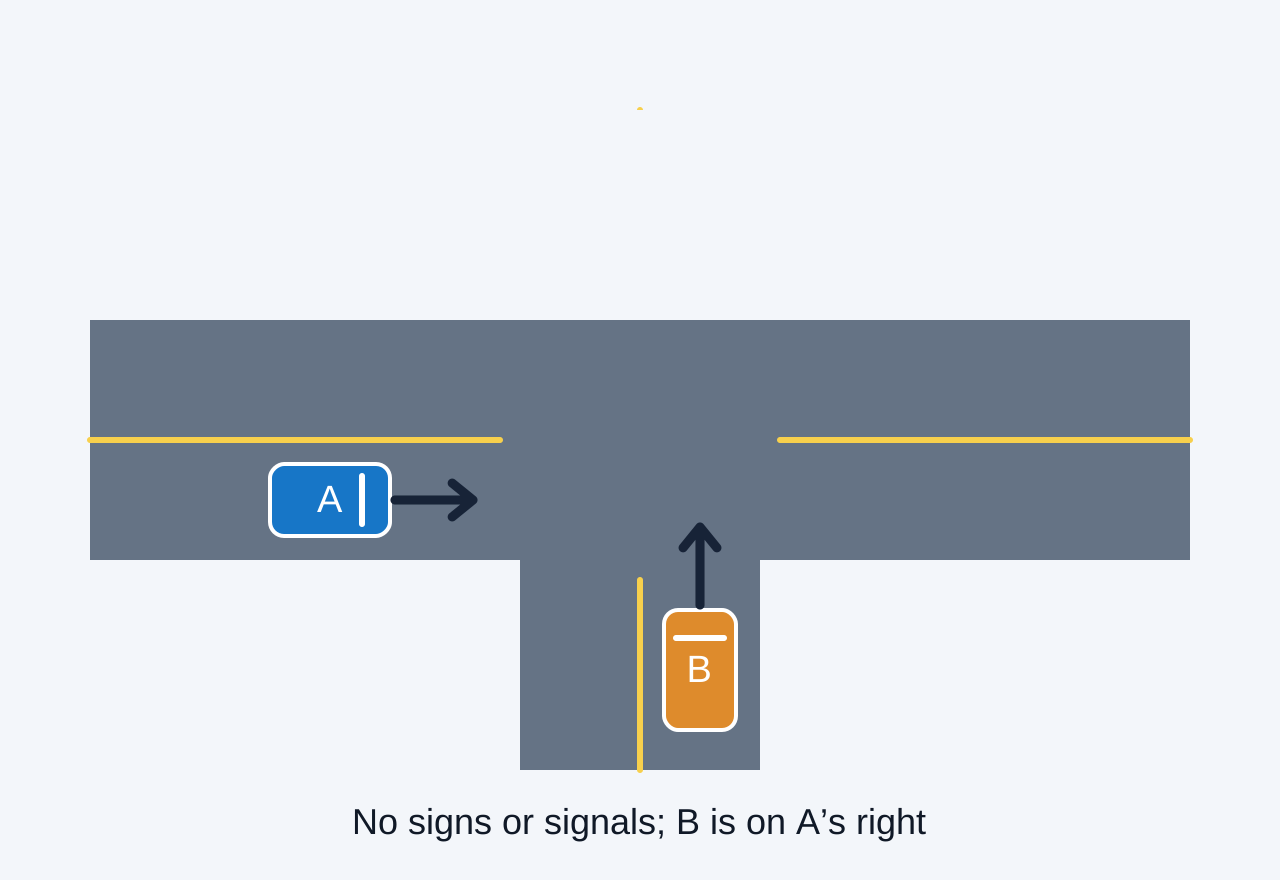
A thinks, "My road keeps going, so I have priority." What is wrong with that idea at this T intersection?
- A. A is right; the through road always has priority
- B. Priority goes to the road with more lanes
- C. With no signs, the right-hand rule applies here too
- D. Priority goes to the driver who arrives last
Show answer
Answer: C. With no signs, the right-hand rule applies here too
Alberta treats the uncontrolled T as a unique case: the driver on the right has the right-of-way.
Question 2 · Hazards
During hard braking with ABS, you feel a vibration in the pedal. What should you do?
- A. Release the brake
- B. Pump the brake
- C. Keep pressing; it is normal
- D. Stop the car another way
Show answer
Answer: C. Keep pressing; it is normal
The vibration means ABS is working.
Question 3 · Intersections
You and another driver stop at an all-way stop at the same time. The other driver is on your right. Who goes first?
- A. The other driver
- B. Whoever is going straight
- C. Whoever signals first
- D. You
Show answer
Answer: A. The other driver
When two vehicles arrive together, courtesy lets the driver on the right go first.
Question 4 · Road Scenarios
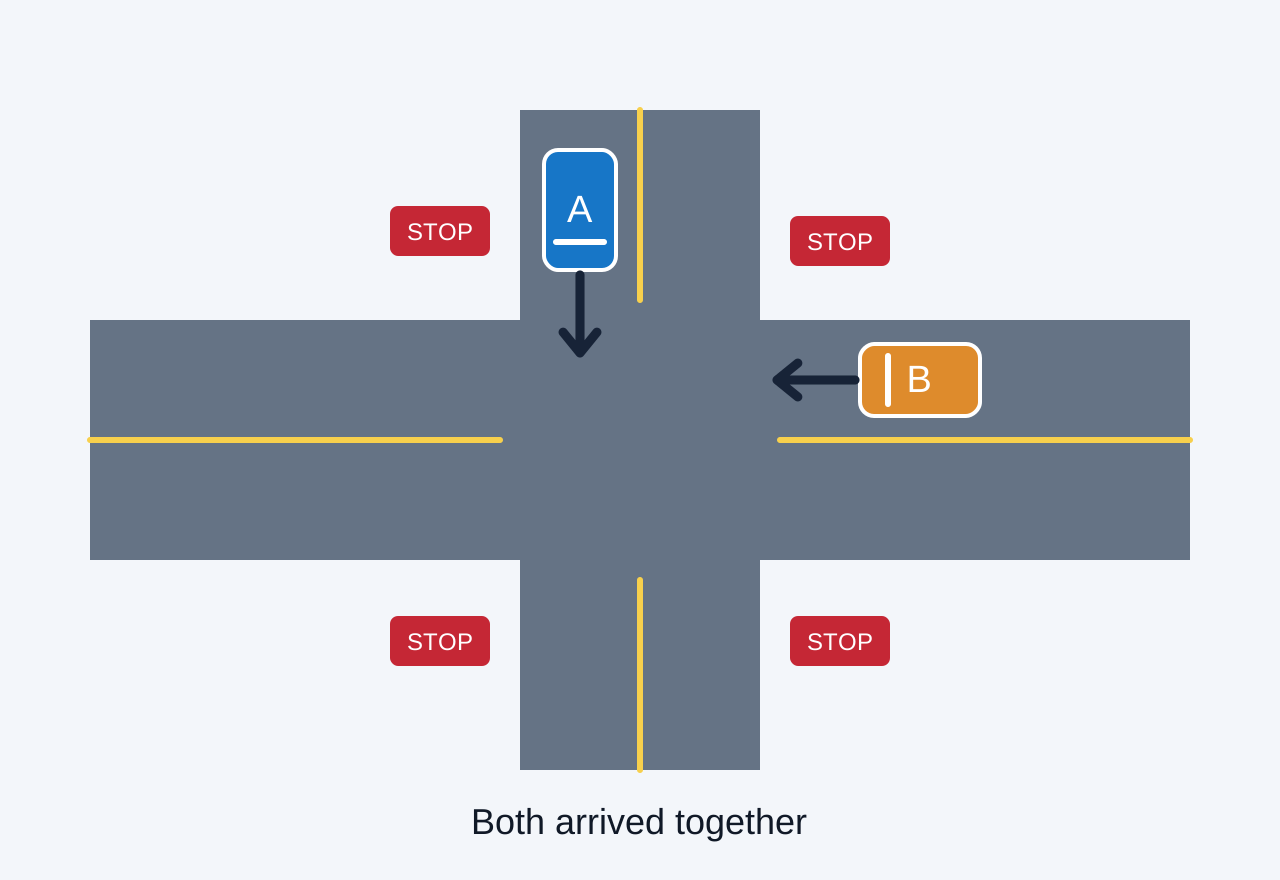
A and B stop at an all-way stop at the same time. A is on B's right. What should B do?
- A. Wave A through and then follow closely behind
- B. Wait for A to go, then proceed when it is safe
- C. Go at the same time as A to save time
- D. Go first, because B is turning onto a busier road
Show answer
Answer: B. Wait for A to go, then proceed when it is safe
B has A on the right, so B lets A go first. B then proceeds only when the intersection is clear.
Question 5 · Intersections
You plan to take the first exit from a roundabout. When should you signal right?
- A. You do not need to signal for the first exit
- B. Only once you are inside the circle and moving
- C. As you approach, and keep it on until you exit
- D. After passing the first exit
Show answer
Answer: C. As you approach, and keep it on until you exit
For the first exit, signal right on approach and leave it on until you have exited.
Question 6 · Road Scenarios
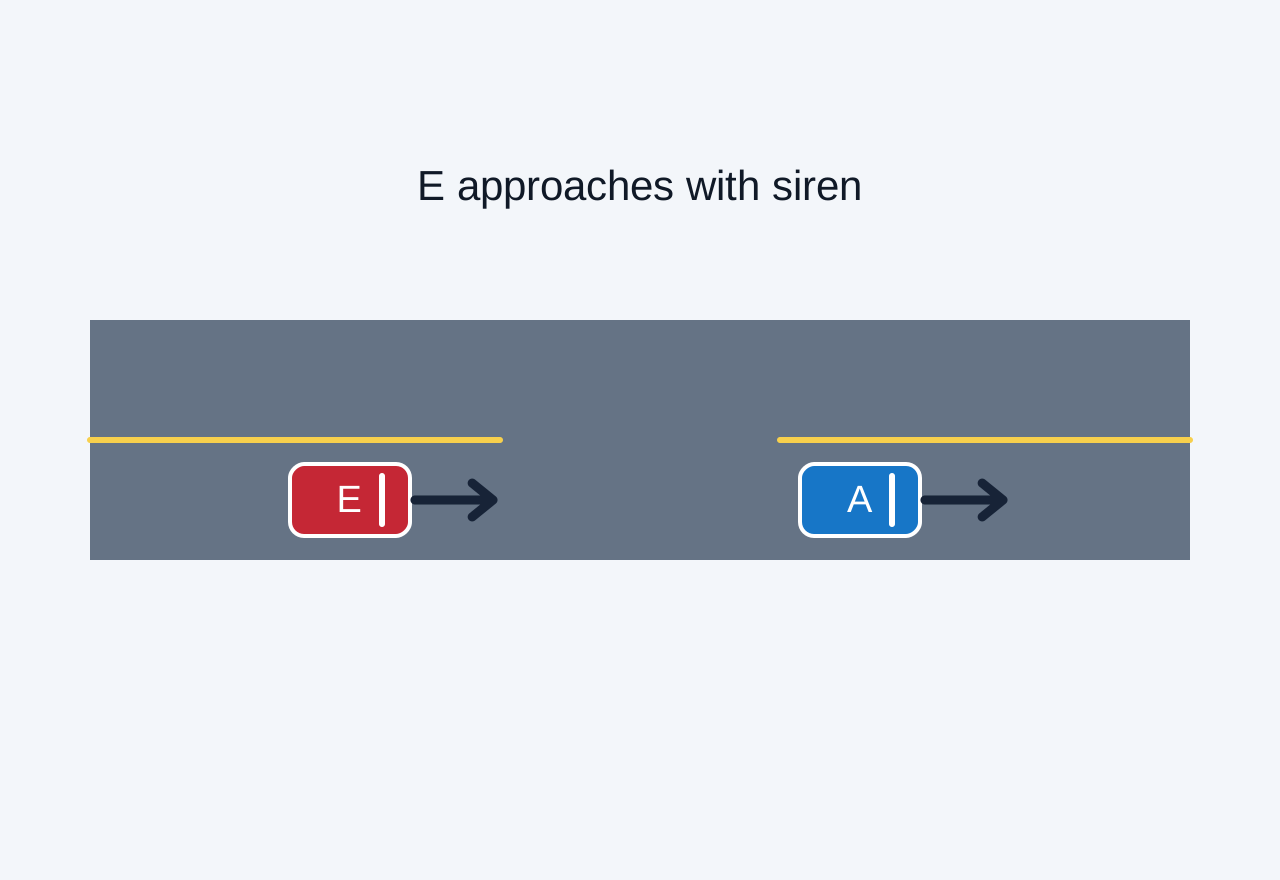
After E has passed A in this scene, what should A do next?
- A. Check traffic and rejoin the lane when it is safe
- B. Follow right behind E to move faster
- C. Pull out quickly before other cars move
- D. Stay stopped until no vehicles are in sight
Show answer
Answer: A. Check traffic and rejoin the lane when it is safe
Once the emergency vehicle has passed, check behind and pull out safely.
Question 7 · Licensing
Friends ask a learner's supervisor to squeeze one extra person into the back seat. What should happen?
- A. Allow it, but only for a short local drive
- B. Allow it if the extra person is small and light
- C. Allow it if two people share one seat belt
- D. Refuse, since every person needs their own seat belt
Show answer
Answer: D. Refuse, since every person needs their own seat belt
Each person needs a working seat belt. Extra passengers cannot share belts.
Question 8 · Safe Driving
Which is a sign of driver fatigue?
- A. Missing an exit or not remembering the last few kilometres
- B. Feeling hungry partway through a long trip
- C. Noticing more traffic than usual
- D. Wanting to change the radio
Show answer
Answer: A. Missing an exit or not remembering the last few kilometres
Lapses in memory and missing exits are warning signs of fatigue.
Question 9 · Vehicle Preparation
Why should you clear snow from your car's roof?
- A. It can slide onto the windshield or fly off at others
- B. It makes the car heavier
- C. It is just for appearance
- D. It melts quickly anyway once the car warms up
Show answer
Answer: A. It can slide onto the windshield or fly off at others
Snow from the roof can block your view or hit other drivers.
Question 10 · Road Scenarios
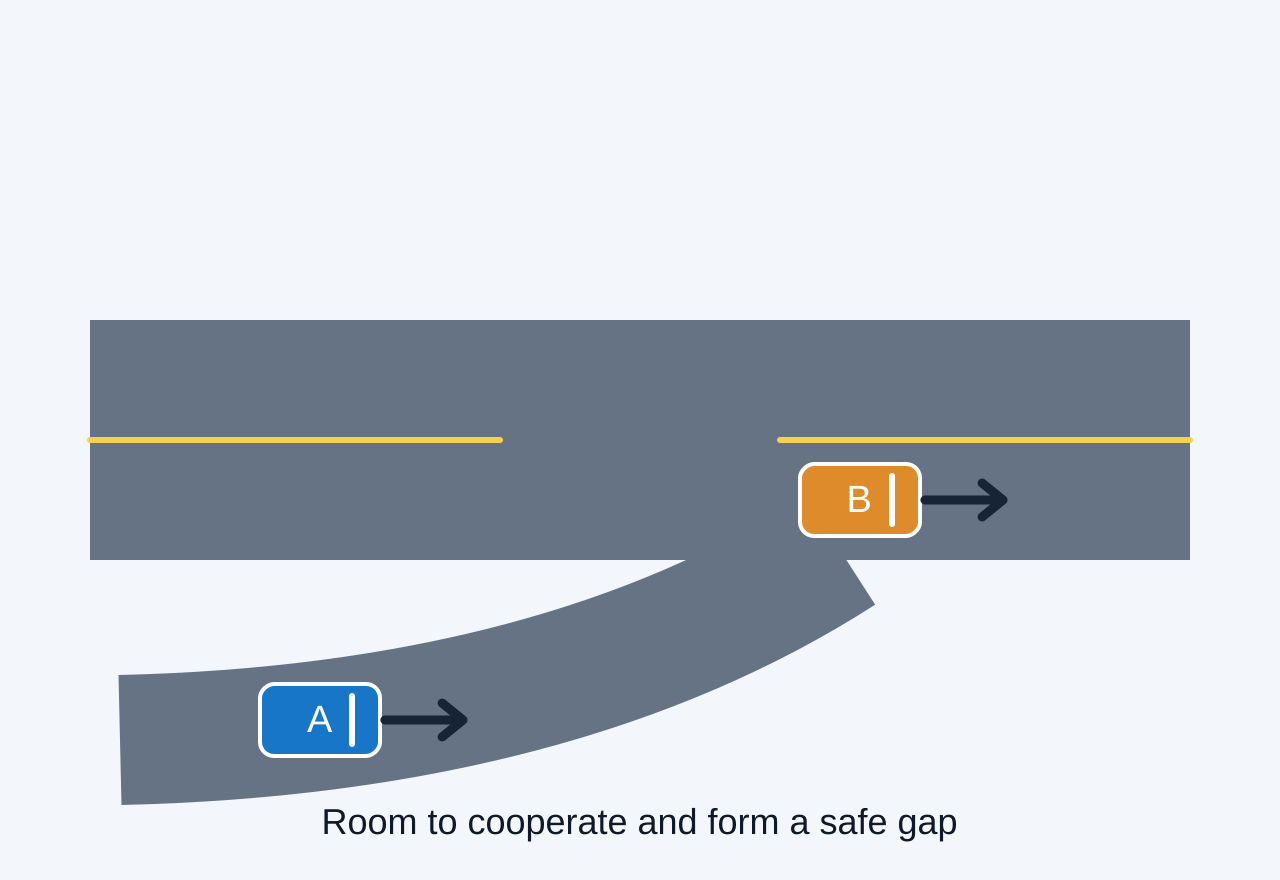
A is in the acceleration lane in this scene. How should A use it?
- A. Drive slowly to the end of the lane, then merge
- B. Speed up to match traffic and look for a safe gap
- C. Stop at the start of the lane and wait for a gap
- D. Merge right away from the start without checking
Show answer
Answer: B. Speed up to match traffic and look for a safe gap
The acceleration lane is for matching the speed of traffic so you can merge smoothly.
Question 11 · Highways
Where should you position your car while being passed on a two-lane highway?
- A. To the right side of your lane
- B. In the centre
- C. On the shoulder
- D. To the left side of your lane
Show answer
Answer: A. To the right side of your lane
Moving right gives the passing driver a better view ahead.
Question 12 · Signs and Signals
You are on a two-way street at a red light and want to turn left onto a one-way street. May you turn?
- A. No, you must wait for the light to change
- B. Yes, after coming to a full stop first
- C. Yes, if you are already in the left lane
- D. Yes, if no traffic is approaching
Show answer
Answer: A. No, you must wait for the light to change
A left on red is only allowed from a one-way street onto another one-way street.
Question 13 · Parking
A fire hydrant is set back from the curb on a boulevard. From where do you measure the 5 metres?
- A. From the nearest driveway
- B. From the closest crosswalk
- C. From the hydrant itself, across the grass
- D. From the point on the curb nearest the hydrant
Show answer
Answer: D. From the point on the curb nearest the hydrant
When a hydrant is not at the curb, do not park within 5 metres of the point on the curb nearest it.
Question 14 · Signs and Signals

The car ahead of you stops at this sign and then drives through. You pull up behind it. What now?
- A. Follow it through, since it already stopped for both cars
- B. Sound your horn to confirm the way is clear and go
- C. Treat the sign as satisfied because traffic is light
- D. Stop at the proper stopping point yourself before you proceed
Show answer
Answer: D. Stop at the proper stopping point yourself before you proceed
Each driver must make their own full stop. Another vehicle's stop does not count for you.
Question 15 · Road Scenarios
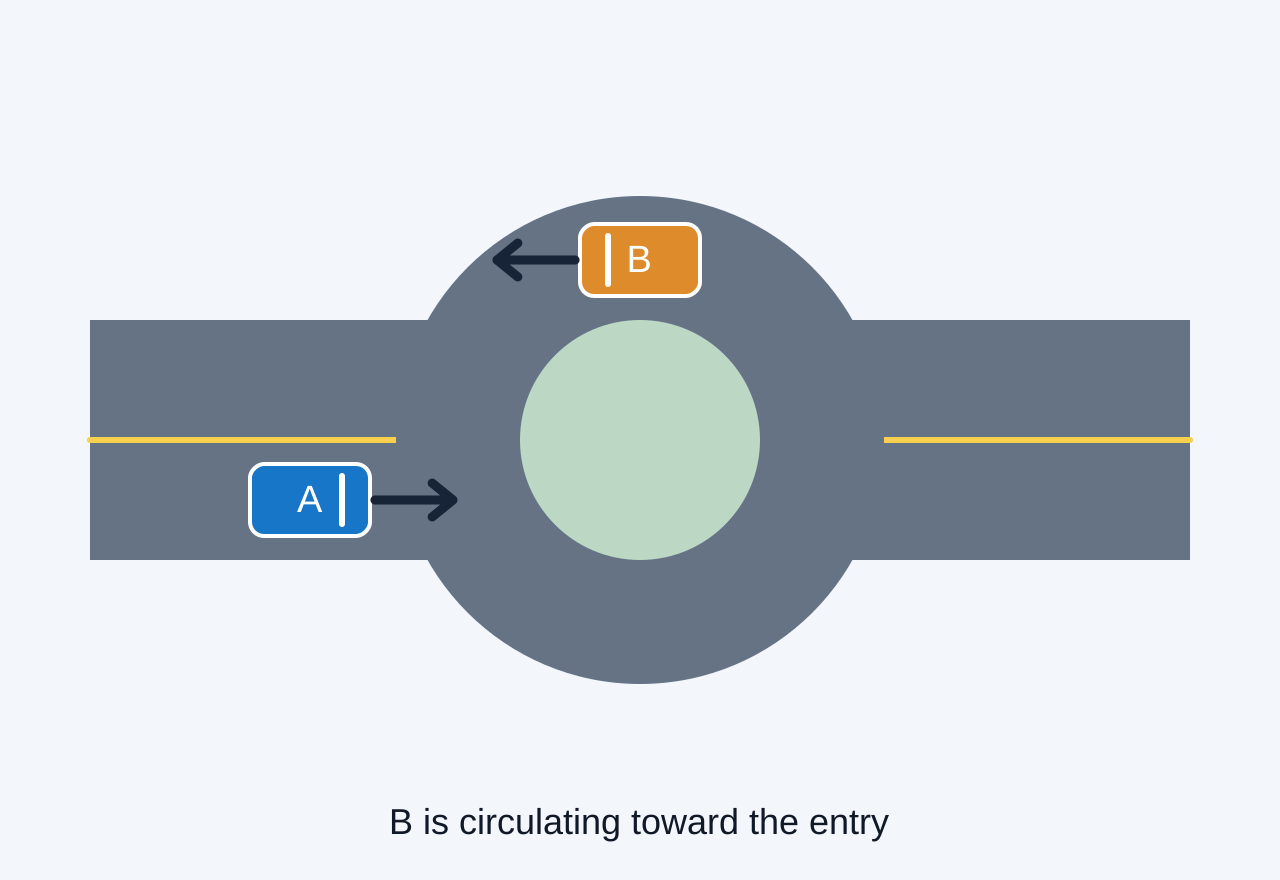
Which direction will A travel once A enters this roundabout?
- A. Clockwise around the centre island
- B. Straight across the centre island
- C. Counterclockwise around the centre island
- D. Whichever way leads to the closest exit
Show answer
Answer: C. Counterclockwise around the centre island
Traffic always circulates counterclockwise around the centre island.
Question 16 · Road Scenarios
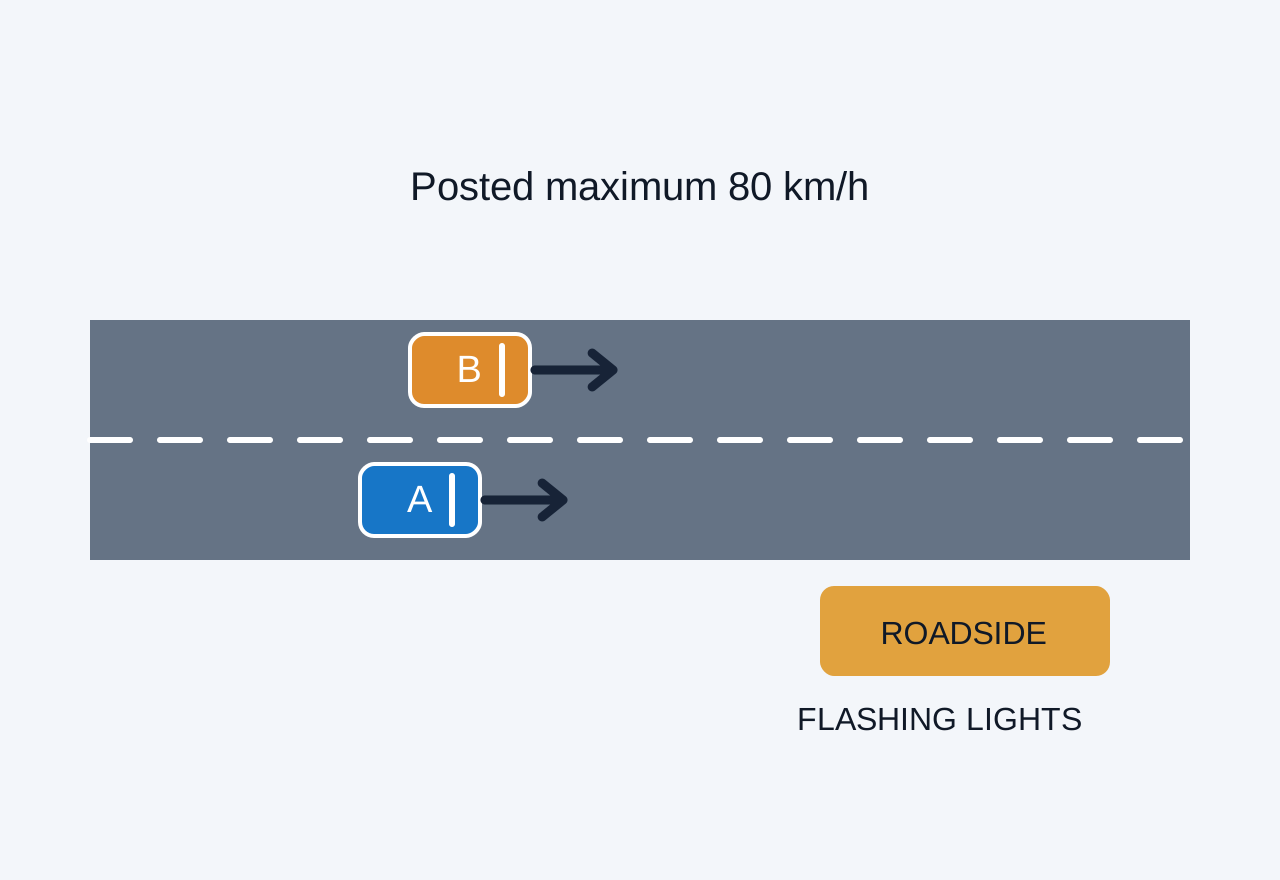
If the posted limit here were 50 km/h instead of 80, how fast could A go past the tow truck?
- A. Any speed under 80 km/h
- B. Up to 60 km/h
- C. No more than 50 km/h
- D. Up to 70 km/h
Show answer
Answer: C. No more than 50 km/h
The rule is 60 km/h or the posted limit, whichever is lower. With a 50 km/h limit, 50 applies.
Question 17 · Signs and Signals
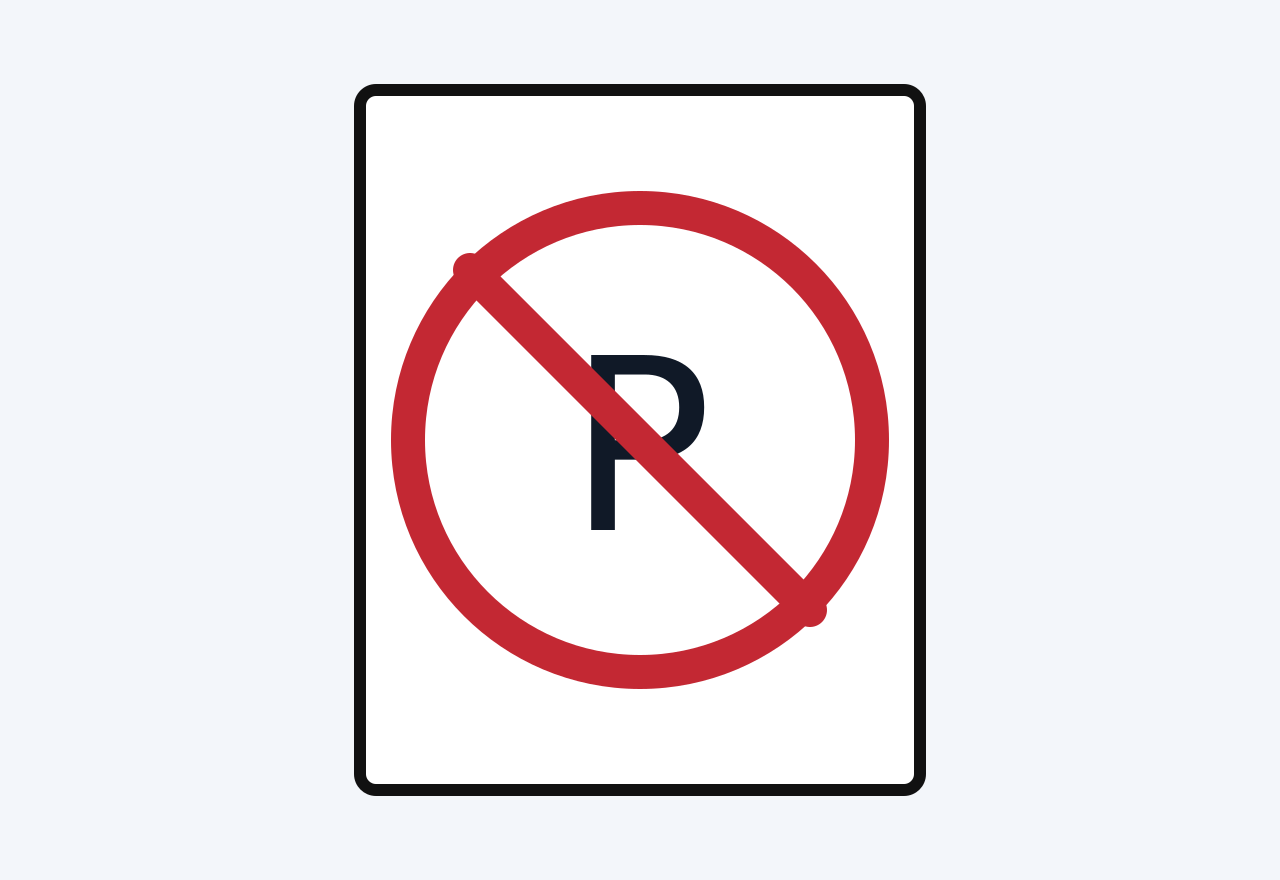
You need to run into a store for two minutes. The only free space is next to this sign. What should you do?
- A. Park with your hazard lights on, since it is short
- B. Find a place where parking is allowed
- C. Park and leave the engine running so you can move
- D. Park if a passenger stays in the car for you
Show answer
Answer: B. Find a place where parking is allowed
A short stay, hazard lights or a running engine do not override a parking prohibition.
Question 18 · Sharing the Road
Why should you give a cyclist extra space when passing?
- A. Cyclists are unable to see cars behind
- B. Cyclists must always ride in the centre
- C. They may swerve to avoid potholes or debris
- D. Bicycles are much wider than they look
Show answer
Answer: C. They may swerve to avoid potholes or debris
Cyclists may need to move suddenly for hazards.
Question 19 · Signs and Signals
It is a holiday Monday at 2:00 p.m. You approach a playground zone with no time tab. What applies?
- A. The playground zone limit is in effect
- B. Only a suggested speed
- C. No limit, because school is closed
- D. No limit, because it is a holiday
Show answer
Answer: A. The playground zone limit is in effect
Playground zones apply every day, including holidays.
Question 20 · Hazards
The gates at a railway crossing are going down. What should you do?
- A. Reverse away quickly and find another crossing
- B. Stop and wait until they are fully up
- C. Drive around them
- D. Speed up to cross
Show answer
Answer: B. Stop and wait until they are fully up
Never drive around lowered gates.
Question 21 · Signs and Signals
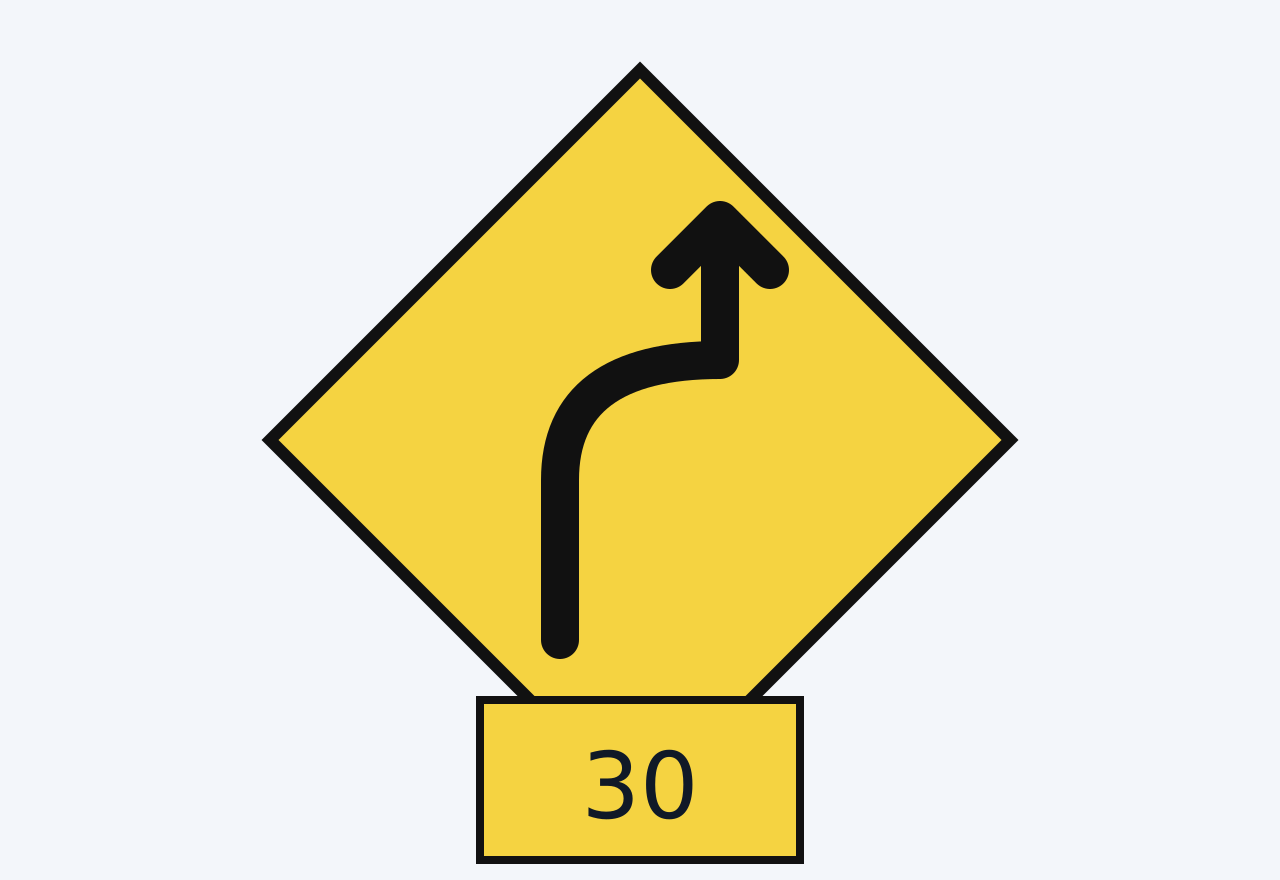
The road is icy as you pass this sign. Which speed is right for the curve?
- A. Any speed, as long as you brake in the curve
- B. Exactly the speed shown on the tab
- C. Slower than the speed shown on the yellow tab
- D. The regular posted limit for the road
Show answer
Answer: C. Slower than the speed shown on the yellow tab
The advised speed is for good conditions. In ice, snow or rain you need to go slower.
Question 22 · Licensing
Jordan turns 14 next week and wants to start learning to drive. Which statement is accurate?
- A. Jordan can apply now, a week early, if a parent attends
- B. Jordan can drive alone at 14 after passing the knowledge test
- C. Jordan must wait until 16 to apply for any kind of licence
- D. Jordan can apply at 14 with consent and a passed knowledge test
Show answer
Answer: D. Jordan can apply at 14 with consent and a passed knowledge test
The minimum age is 14. Jordan also needs parental consent, ID and a passed knowledge test.
Question 23 · Signs and Signals
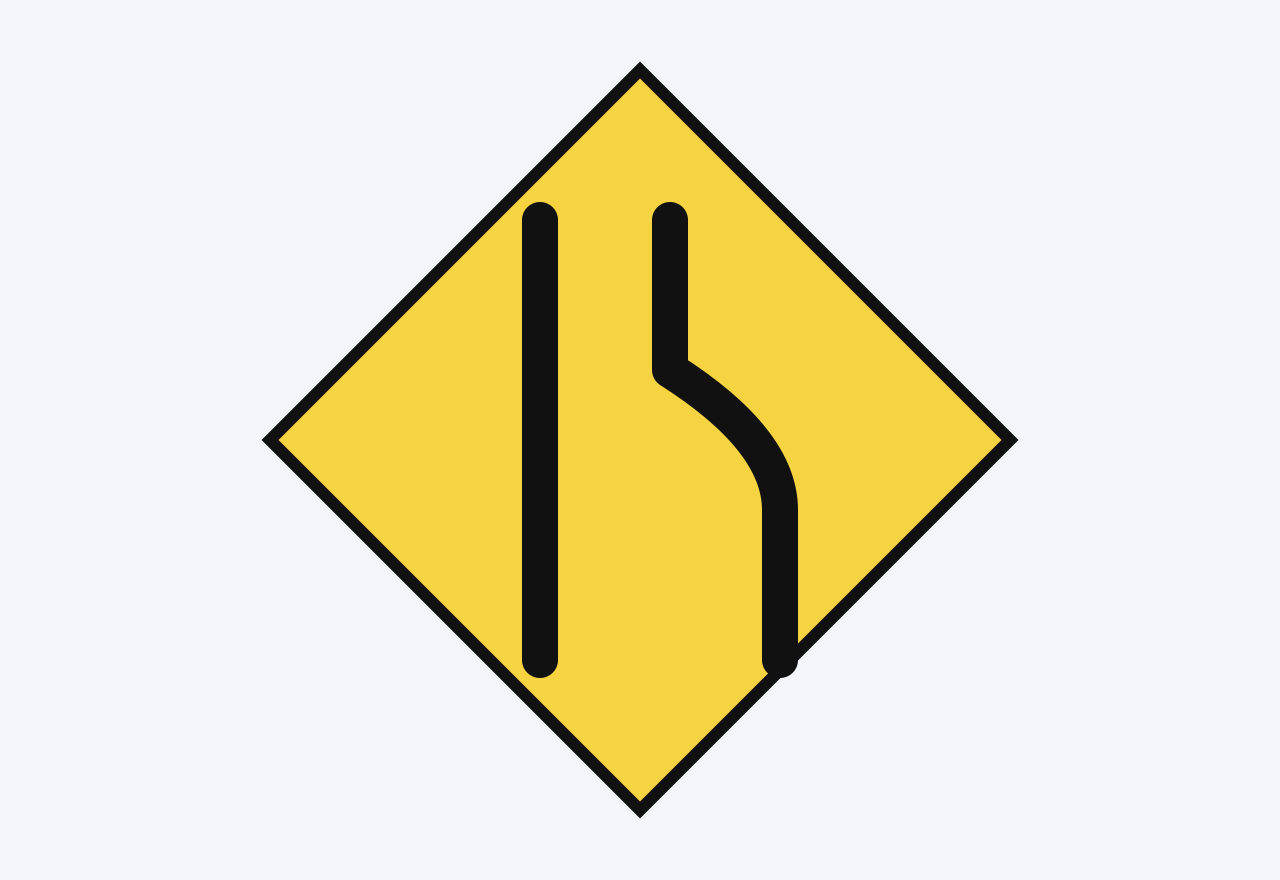
You are in the lane that ends. When should you start looking for a gap?
- A. As soon as you see the warning
- B. Only when the lane markings disappear
- C. Only if a vehicle is beside you
- D. After you reach the end of the taper
Show answer
Answer: A. As soon as you see the warning
Spotting the warning early gives you time to adjust speed and merge smoothly.
Question 24 · Parking
While reversing, where should you mainly look?
- A. At the dashboard camera screen only
- B. Straight ahead through the windshield
- C. Over your shoulder through the rear window
- D. At the two side mirrors only
Show answer
Answer: C. Over your shoulder through the rear window
Looking back directly gives the best view. Cameras and mirrors help but leave gaps.
Question 25 · Sharing the Road
Why should you stay well back from a snowplow?
- A. To see its flashing lights better
- B. To save fuel in cold weather by drafting behind it
- C. So you can read the phone number on the back
- D. To have time to react and avoid sand or gravel it spreads
Show answer
Answer: D. To have time to react and avoid sand or gravel it spreads
Following too closely risks collisions and windshield damage.
Question 26 · Signs and Signals
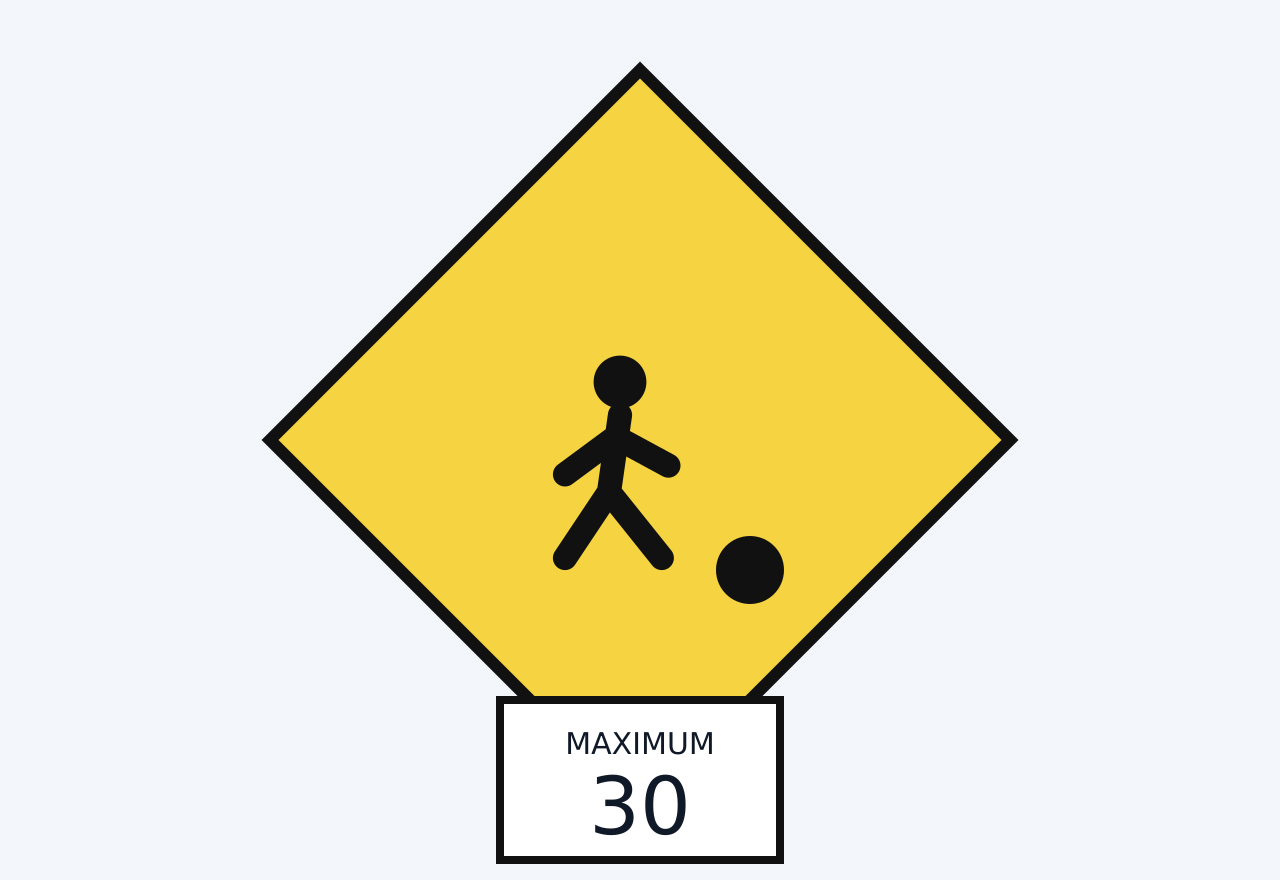
On which days does this zone's limit normally apply?
- A. Every day of the week, including weekends and holidays
- B. Only on weekends and statutory holidays
- C. Only from May to September, every day
- D. Only on school days, Monday to Friday, during class hours
Show answer
Answer: A. Every day of the week, including weekends and holidays
Unlike school zones, playground zones normally apply every day, unless a local tab says otherwise.
Question 27 · Highways
At a yield-controlled entry, is a full stop always required?
- A. No, only when needed
- B. Only if a truck is coming
- C. Only at night
- D. Yes, every single time
Show answer
Answer: A. No, only when needed
You must yield, and stop only if needed to avoid conflict.
Question 28 · Safe Driving
How can you check your following distance?
- A. Count seconds after the car ahead passes a fixed point
- B. Count the cars between you and the next traffic light
- C. Match the distance other drivers are leaving
- D. Use your car's length
Show answer
Answer: A. Count seconds after the car ahead passes a fixed point
When the car ahead passes a landmark, count. You should not reach it before two seconds.
Question 29 · Hazards
Why should you dim your lights when following closely at night?
- A. Dimming saves fuel on long drives
- B. Low beams let you see the car ahead better
- C. It is only polite, and has nothing to do with safety
- D. Your high beams can glare in the other driver's mirrors
Show answer
Answer: D. Your high beams can glare in the other driver's mirrors
High beams reflected in mirrors can dazzle the driver ahead.
Question 30 · Signs and Signals
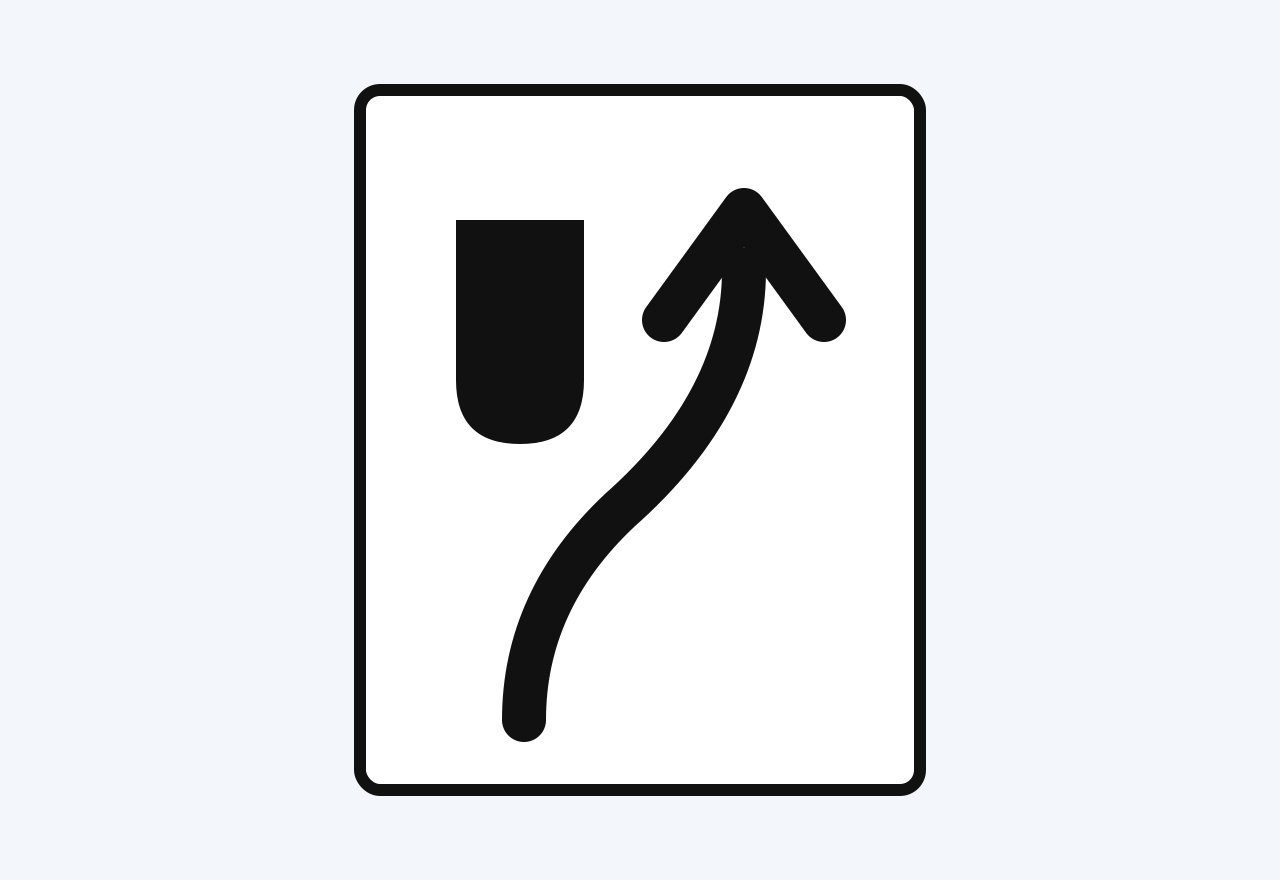
You see this sign on a median island at an intersection. How should you pass the island?
- A. Pass on whichever side has less traffic
- B. Pass with the island on your left side
- C. Drive over the low part of the island
- D. Pass with the island on your right side
Show answer
Answer: B. Pass with the island on your left side
Keeping right of the island means the island stays on your left as you go by.
Ready to test yourself?
Take a 30-question practice exam with the answers hidden. You get a score (pass with 25 of 30, like the real test) and an explanation for every answer. For the real test, see about the Class 7 knowledge test.
More free practice and lessons
- Free Alberta Class 7 practice test
- Road signs practice test
- Rules of the road practice test
- Alberta Class 7 Practice Mock Exam 1 with answers
- Alberta Class 7 Practice Mock Exam 2 with answers
- Alberta Class 7 Practice Mock Exam 3 with answers
- Alberta Class 7 Practice Mock Exam 4 with answers
- Alberta Class 7 Practice Mock Exam 5 with answers
- Alberta Class 7 Practice Mock Exam 7 with answers
- Reading signs by shape and colour
- Traffic lights and turns on red
- School and playground zones
- Right-of-way at stops and uncontrolled intersections
- Traffic circles and roundabouts
- Parking on hills
- Where you can't park
- Space, scanning and following distance
- Distraction and impairment
- Merging, exiting and passing
- Lane markings and passing
- School buses and emergency vehicles
- Roadside workers, tow trucks and snowplows
- Cyclists, motorcycles and large trucks
- Night, weather and slippery roads
- Skids, blowouts and stalls
- Class 7 learner's licence rules
- Before you drive
- Reading the diagrams
- About the Alberta Class 7 knowledge test
- 7-day study plan
- Study tips