By the ChowChow Labs editorial team · Updated November 13, 2026 · How we check our content
Short answer: When there is no light, right-of-way rules decide who goes first. Alberta has one rule that surprises many drivers: the uncontrolled T intersection.
Key points
- All-way stop: the first to stop goes first. If two arrive together, the driver on the right goes first.
- No signs or signals: yield to the vehicle on your right.
- Uncontrolled T intersection: the driver on the right still has the right-of-way, even if they're on the road that ends.
- Left turns yield to oncoming traffic, even on a solid green.
- Turning drivers yield to pedestrians in marked or unmarked crosswalks.
Law or advice?
These are legal duties. Even with the right-of-way, you must still try to avoid a collision.
Example
You're driving along the top of a T with no signs. A car comes up the stem on your right. You yield to it, even though your road continues.
Checked against the Government of Alberta Driver’s Guide (Spring 2026), used under the Open Government Licence – Alberta. Laws change, so check alberta.ca for the current rules before you rely on a number. Sources: Alberta Driver’s Guide, page 59: Uncontrolled intersections.
Check yourself
Try these 6 questions from our free mock exams, then tap Show answer. For more, take the rules of the road practice test.
Question 1 · Intersections
At an intersection with no signs or signals, a vehicle approaches from your right at the same time. What should you do?
- A. Go first, since you are going straight
- B. Speed up to cross first
- C. Go first if your road is wider
- D. Yield to the vehicle on your right
Show answer
Answer: D. Yield to the vehicle on your right
At uncontrolled intersections, yield the right-of-way to a vehicle on your right.
Question 2 · Intersections
Three vehicles stop at an all-way stop at different times. Which goes first?
- A. The vehicle going straight
- B. The vehicle on the main road
- C. The vehicle that stopped first
- D. The largest vehicle
Show answer
Answer: C. The vehicle that stopped first
At an all-way stop, the first vehicle to stop proceeds first, when it is safe.
Question 3 · Intersections
At a T intersection with no signs or signals, who has the right-of-way?
- A. Whoever is going faster
- B. The driver on the road that ends
- C. The driver on the right
- D. The driver on the road that continues
Show answer
Answer: C. The driver on the right
In Alberta, an uncontrolled T intersection follows the right-hand rule.
Question 4 · Road Scenarios
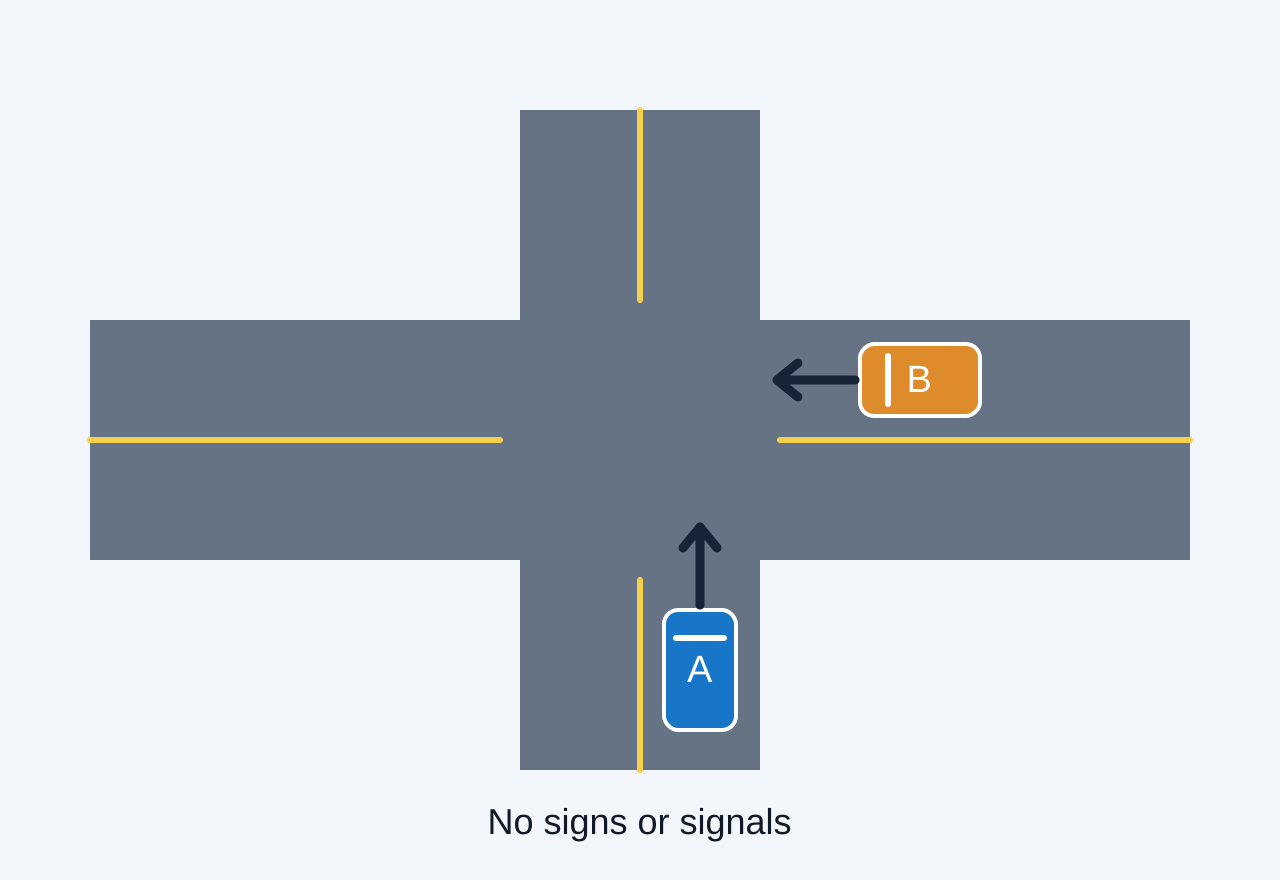
At an intersection with no signs or signals, B is approaching on A's right. What should A do?
- A. Go first if A's road looks wider
- B. Yield to B and cross only when it is safe
- C. Speed up so B has to slow down
- D. Go first, because A is travelling straight
Show answer
Answer: B. Yield to B and cross only when it is safe
At an intersection with no signs or signals, you must yield to a vehicle approaching from your right.
Question 5 · Intersections
You are in a roundabout and plan to take the third exit. When should you turn on your right signal?
- A. Before entering the roundabout, so everyone knows your plan early
- B. After passing the exit before the one you will use
- C. Right after you enter the circle
- D. After you have left the roundabout
Show answer
Answer: B. After passing the exit before the one you will use
Signal right after you pass the exit just before yours.
Question 6 · Intersections
You miss your exit in a roundabout. What should you do?
- A. Continue around and take the exit on the next pass
- B. Stop in the circle and wait for a gap to reach it
- C. Cut across the other lane to reach the exit
- D. Reverse back along the circle to the exit
Show answer
Answer: A. Continue around and take the exit on the next pass
If you cannot exit safely, continue around the circle and try again.
Next: Traffic circles and roundabouts. Circular intersections keep traffic moving counterclockwise around a centre island. Alberta has specific rules for two-lane circles.